

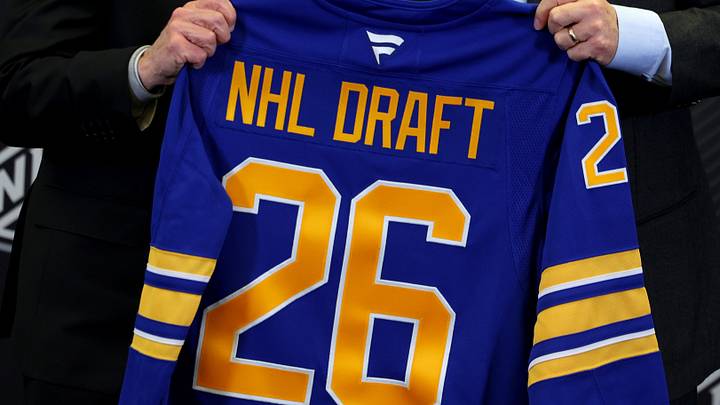
Every June since 2015, the NHL has gathered its brightest young prospects in Buffalo and subjected them to the most bizarre ritual in professional sports: the pre‑draft interview. It’s supposed to be a window into character, maturity, and mental sharpness. Instead, it’s become a traveling circus of psychological riddles, macho posturing, and questions so deranged they’d get a middle‑school guidance counselor fired.
And this year’s headliner? Caleb Malhotra.
The top 2026 prospect sat down expecting to talk systems, skating, maybe even his shot release. Instead, he got a hypothetical straight out of a dystopian survival movie:
“If you were on a desert island with no fresh water for a day, but the person next to you had a water bottle, would you kill that person for their water bottle?”
That wasn’t a joke. That wasn’t a prank. That was an NHL team — a real one, with a real front office — asking a teenager if he’d commit murder for hydration.
This is the NHL Combine in a nutshell: a league desperate to look smart while proving, year after year, that it has no idea what intelligence actually looks like.
The NHL’s Favorite Tradition... Reinventing a Wheel That Isn’t Broken
No league tries harder to out–galaxy‑brain itself than the NHL. Instead of trusting scouts, development models, analytics, or — wild concept — actual hockey performance, teams cling to the belief that the secret to drafting well lies in asking a 17‑year‑old whether he’d bludgeon a stranger for a bottle of Dasani.
It’s the same insecurity that leads GMs to overthink obvious picks, fall in love with “intangibles,” and convince themselves that a kid’s reaction to a hypothetical death match is somehow predictive of his ability to run a power play.
The wheel works. The NHL just keeps trying to turn it into a Rubik’s Cube.
A Hall of Fame of Horrible Questions
Malhotra’s desert‑island murder scenario isn’t an outlier — it’s part of a long, embarrassing lineage of Combine questions that would get HR departments sued in any other industry.
Bizarre & Gruesome Scenarios
The Montreal Desert Island Bat Test: A prospect was asked what he’d do if his companion drank the only water on a deserted island — with a baseball bat added for dramatic effect, as if the Canadiens were workshopping a Saw sequel.
The 20-Foot Python: John Farinacci — drafted 76th overall by Arizona in 2019 and now a Bruins prospect — was asked how he’d react if a giant python was loose in the hallway and someone in the room had to confront it.
The Wartime Bombing Question David Reinbacher, drafted 5th overall by Montreal in 2023, was asked if he’d bomb an enemy ship even if his own teammates were in the water. Reinbacher refused — because he’s a human being — and somehow that was considered a “revealing” answer.
Inappropriate & Harsh Interrogations
The “Pussy” Incident: An NHL executive once straight up asked a top prospect if he was a “pussy.” That’s not scouting — that’s a lawsuit waiting to happen.
The Class Warfare Question: A first round American prospect was grilled with, “Why would we draft a rich kid from the suburbs when we could take a farm boy from Western Canada?”
Yakupov vs. Burke: Nail Yakupov’s interview with Anaheim got so heated it nearly turned physical, prompting Brian Burke to warn other teams about his “attitude.” Yakupov went first overall anyway.
None of these questions predicted anything. None correlated with NHL success. None made a team smarter.......They just made the league look dumber. Let’s be blunt.... There is zero evidence — none — that these interviews predict NHL success.
Some of the worst interview performers became All‑Stars.
Some of the “best interview guys” never played a single NHL game.
Some teams still draft based on vibes, grit, and whether a kid can solve a hypothetical hostage situation.
Meanwhile, the teams that draft well — Tampa, Dallas, Carolina — do it because they scout well, develop well, and trust their process. Not because they asked a teenager if he’d kill someone for a water bottle.
The Real Problem: A League Terrified of Being Wrong
Draft the best hockey players.
Talk to their coaches.
Watch their tape.
Evaluate their development curve.
Assess their character through real conversations, not desert‑island murder fantasies.
But the NHL can’t help itself. It loves the illusion of complexity. It loves the idea that there’s a magic question that separates the next McDavid from the next Yakupov.
There isn’t. There never has been
Until Then, the Circus Rolls On
Caleb Malhotra’s desert‑island question will be forgotten by next year — replaced by something even stranger, even more pointless, even more revealing of a league that still hasn’t figured out how to get out of its own way.
The NHL doesn’t need to reinvent the wheel. It needs to stop throwing the wheel into a blender and asking prospects how they’d escape.
 Add us as a preferred source on Google