

The NHL trade deadline arrived with its usual circus.
Wall-to-wall coverage. Insider tweets flying every five minutes. Panels on television speaking in breathless tones like something seismic was about to happen.
Nineteen teams moved 30 players and 20 draft picks, which sounds like a lot until you actually watched the day unfold. This wasn’t a frenzy. It wasn’t chaos. It felt more like a quiet accounting exercise. Easily one of the most uneventful NHL trade deadlines in recent memory.
From a Rangers perspective, the day barely registered. Low event. Low drama. Mostly housekeeping. Which is strange considering how much anticipation surrounded it.
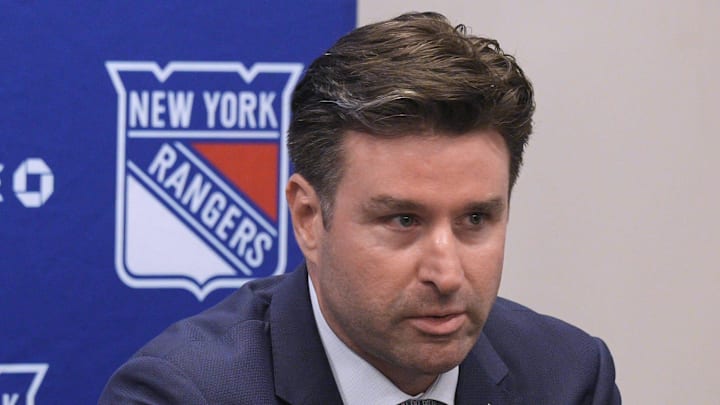
Back in January, Rangers President and GM Chris Drury released what quickly became known among fans as “The Letter 2.0.” It was the kind of organizational message that signals change. Not tweaks. Real change. The kind that makes everyone in the room glance around and quietly wonder who might be next.
Then came the move that truly shifted the temperature in the building: Artemi Panarin was traded a few weeks later. When you move a player of that magnitude in the middle of a season, the message becomes clear. Nobody is untouchable. The direction of the team is shifting, and the front office is willing to make uncomfortable decisions to get there.
Vincent Trocheck’s name circulated heavily. Braden Schneider popped up in conversations. And once the Rangers signaled they were willing to move major pieces, it suddenly felt like anyone wearing a blue sweater could find themselves in a deadline deal.
The rumor mill spun fast. At one point, NHL insiders were speaking about a potential Vincent Trocheck trade to the Minnesota Wild as if it were practically done. Except deals aren’t real until they’re signed. And this one never got there.
It appears Chris Drury was trying to squeeze every ounce of value out of the potential move. Minnesota GM Bill Guerin, however, wasn’t interested in overpaying. Eventually Guerin simply pivoted. The Wild moved on and instead added Bobby Brink from the Philadelphia Flyers and Nick Foligno from the Chicago Blackhawks.
Translation: Guerin called Drury’s bluff. And the Trocheck deal quietly disappeared.
While the headline move never materialized, the Rangers did make three smaller trades throughout the day — two of which nudged the organization slightly further into its re-tool.
The first move sent Sam Carrick to the Buffalo Sabres in exchange for a 2026 third-round pick and a sixth-round pick. It’s the type of move that doesn’t dominate headlines but makes sense when you look at it closely. Carrick is a depth player — hardworking, reliable, but replaceable. Turning that into two draft picks is simply good asset management.
Carrick should fit Buffalo well as they continue trying to push toward relevance in the Eastern Conference. Of course, if recent Sabres history tells us anything, that relevance tends to end with an early playoff exit. Still, credit where it’s due: new Sabres GM Jarmo Kekäläinen appears willing to push his chips forward with the roster he mostly inherited after Kevyn Adams was fired earlier this season.
The Rangers’ second move of the day was more of a prospect play. Defenseman Derrick Pouliot was dealt to the Chicago Blackhawks for Aidan Thompson, a 24-year-old rookie forward from the University of Denver.
Thompson was part of Denver’s 2024 National Championship team and finished his collegiate career with 117 points in 120 games. That’s legitimate production at the NCAA level. Still, projecting how that translates to the NHL is another question entirely.
Right now, Thompson profiles as a player who may spend significant time with the Hartford Wolf Pack, working his way into the organization’s depth chart. Maybe he earns occasional call-ups. Maybe he surprises people. Hockey development has a funny way of doing that. But at the moment, he feels like organizational depth rather than a guaranteed NHL contributor.
The Rangers’ most notable move of the deadline came when they traded Brennan Othmann to the Calgary Flames in exchange for Jacob Battaglia.
For a while, Othmann was something of a fan favorite among Rangers supporters. Drafted 16th overall in 2021, he was viewed as a potential future spark plug — a winger who could bring energy, grit, and secondary scoring to a team that sometimes leans too heavily on finesse.
But development paths rarely move in straight lines.
Othmann never quite looked comfortable during his time with the Rangers. The pace felt slightly off, the decision-making inconsistent, and the overall fit with the team’s structure never fully clicked. Sometimes a player simply needs a fresh start. Calgary will now provide that opportunity.
In return, the Rangers get Jacob Battaglia, a player still very early in his development. Battaglia was selected 62nd overall in the 2024 NHL Draft and has yet to play an NHL game. At just 19 years old, he remains very much a projection. But the early indicators are intriguing. Battaglia has put up strong numbers with the Kingston Frontenacs in the OHL, and scouting reports consistently describe him as a sneaky opportunistic offensive player.
At 6’1” and 185 pounds, Battaglia isn’t afraid to operate around the net. Screens. Rebounds. Traffic. The messy parts of hockey where goals are often created. That element has been noticeably absent not only from the Rangers’ prospect pipeline but from the NHL roster itself.
He now joins Liam Greentree, acquired in the Panarin trade, as part of the Rangers’ developing young core. Both players will likely spend time with the Hartford Wolf Pack as they transition into the professional ranks before potentially making their way to Madison Square Garden.
So where does all of this leave the 2025–26 New York Rangers?
Unless the hockey gods decide to stage the most miraculous late-season surge imaginable, the Rangers are not heading to the playoffs this year. And that reality shifts the focus. The remaining 22 games of the season are less about wins and losses and more about evaluation. Young players will get looks. Depth players will fight for future roles. Everyone in the organization is essentially skating through an extended audition.
Meanwhile, the front office will be watching the standings with quiet interest. Because the 2026 NHL Draft is shaping up to be a significant one. Prospects like Gavin McKenna, Ivar Stenberg, and Keaton Verhoeff headline what scouts believe could be one of the stronger classes in years. Landing in position to draft one of those players could dramatically accelerate the Rangers’ re-tool.
But the most important decisions looming for the franchise have nothing to do with the draft. They revolve around two names: Igor Shesterkin and Adam Fox.
Those are the pillars. The franchise cornerstones. The players who ultimately determine how fast — or how painful — this re-tool becomes. If both believe in the direction the organization is heading, the Rangers can move through this transition quickly.
If they don’t, the timeline changes entirely. That’s the real story waiting on the horizon. Until then, the Rangers will skate out the final stretch of the season exactly as they are now: a team in transition, playing out the string, while the future slowly comes into focus.
 Add us as a preferred source on Google