

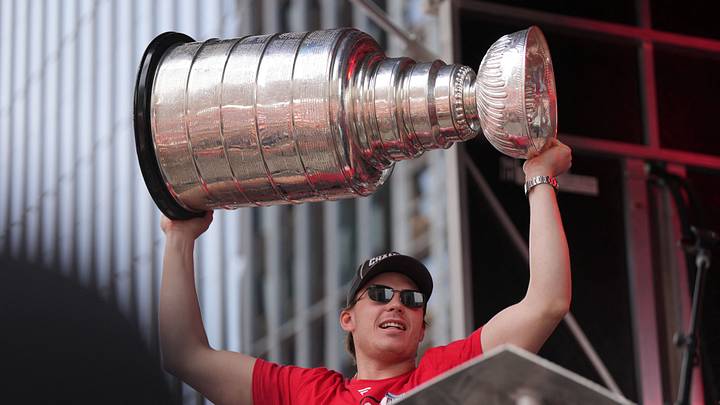
The New York Rangers' blue line nearly looked dramatically different this season. According to NHL Insider Elliotte Friedman, the Rangers and Stanley Cup champion Carolina Hurricanes had agreed to a trade involving Alexander Nikishin. Still, the deal collapsed when New York could not reach a contract agreement with the restricted free-agent defenseman.
Nikishin was reportedly seeking a five-year contract worth around $9 million annually. He had requested a change of scenery after producing 11 goals and 33 points during his first full NHL season, so it is easy to understand why Chris Drury was interested. Nikishin is young, physical, offensively capable, and already looks like a legitimate top-pair defenseman. Adding that type of player next to Adam Fox, or building a second pairing around him, could have changed the complexion of the Blueshirts' defense for years.
Drury pivoted to Sean Durzi and Marcus Pettersson after Nikishin deal collapsed
However, $9 million per season would have changed the complexion of their salary cap, too. Even before knowing what New York would have surrendered in the proposed trade, that contract demand made the move incredibly difficult to justify. Nikishin is talented, but committing $45 million to a defenseman with one full NHL season on his résumé would have represented an enormous gamble. With Fox already earning $9.5 million annually, the Rangers could have had nearly $19 million committed to two defensemen before addressing the rest of the roster.
Drury was willing to pursue the star, but he wasn't willing to hand him a blank check. So instead, he pivoted to addressing the Blueshirts' biggest concern. The Rangers acquired Sean Durzi from the Utah Mammoth as the centerpiece of the Vincent Trocheck trade. Along with Durzi, Drury added center prospect Cole Beaudoin and a 2027 third-round pick. Later that day, they sent a top-10 protected 2030 first-round pick to the Vancouver Canucks for Marcus Pettersson. Those two separate moves created an entirely new second defensive pairing. Instead of acquiring one defenseman at approximately $9 million per season, Drury divided his resources between two proven top-four options.
Sean Durzi is a part of the trade between the New York Rangers and the Utah Mammoth. I always liked his game, especially offensively. I'm curious on him under Sullivan. The Rangers also get Cole Beaudoin and a 3rd round draft pick. pic.twitter.com/hdxv92WxOA
— Rono (@RonoAnalyst) July 1, 2026
Pettersson brought size, stability, and the defensive reliability the Rangers didn't have beyond their top pair of Fox and Vladislav Gavrikov last season. Durzi supplies puck movement, offense and another defenseman capable of running that second power-play unit.
The Canucks trade Marcus Pettersson to the Rangers in exchange for a 2030 first-round pick (top-10 protected), per @FriedgeHNIC 🔄 pic.twitter.com/4gEeJ9bVyc
— Sportsnet (@Sportsnet) July 1, 2026
Yes, Nikishin could become one of the NHL's premier defensemen, and if he does, Rangers fans will naturally wonder what might have been. We also do not know what Carolina would have received in the proposed deal, making it impossible to evaluate the trade itself.
Still, New York's alternative carries considerably less risk. The Blueshirts entered the offseason needing to reduce the steep drop-off between their top duo and everybody else, and Braden Schneider can now move into a more sheltered third-pairing role instead of being forced into assignments he may not be ready to handle consistently. That is a far more balanced group than Mike Sullivan had last season.
Rangers' failed Alexander Nikishin trade explains their entire defensive makeover
This revelation also clarifies Drury's offseason thinking. The acquisitions of Pettersson and Durzi were not merely independent opportunities that materialized on July 1. They appear to have been New York's answer after its pursuit of Nikishin failed.
Nikishin is a 10.2(c) RFA that is not eligible to be offer sheeted, and recently switched representation to Paul Theofanous who is a powerhouse agent that represents stars such as Artemi Panarin and Kirill Kaprizov. He remains unsigned while teams like the St. Louis Blues have also kicked tires.
Drury initially attempted to land one potential cornerstone. When the contract became untenable, he used multiple transactions to address the same weakness collectively. Drury rightfully explored the blockbuster while maintaining financial discipline, walking away from the summer with an entirely reworked second pair anyway. That is not a bad recovery from a trade that came much closer to happening than anybody knew.
 Add us as a preferred source on Google