

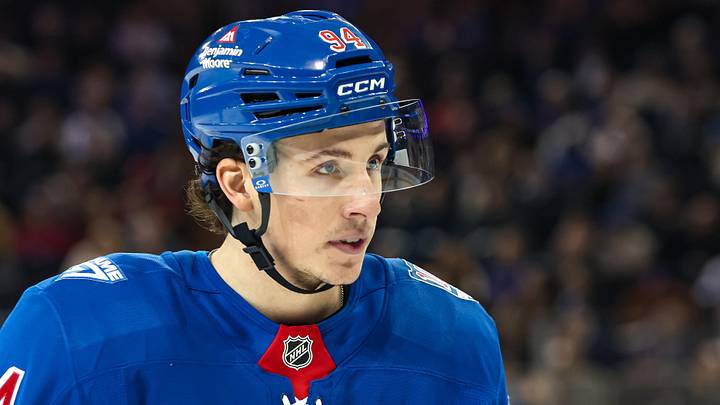
Gabe Perreault’s rookie season did not unfold the way many New York Rangers fans expected. It may have been better because of it.
After dominating at Boston College and starring for the USA Hockey National Team Development Program and winning a couple of World Juniors titles in 2023 and '24, Perreault entered the season surrounded by top-six expectations and franchise-player hype. With the franchise in transition after a colossal 2025 season, Many believed the Blueshirts ’ 2023 first-round pick would step directly into a major offensive role and never look back. Instead, the Rangers sent him to the Hartford Wolf Pack. At the time, the decision frustrated plenty of fans. Looking back now, it may have been exactly what he needed.
Expectations
Perreault entered the year as arguably the Rangers’ top prospect and one of the organization’s most important long-term pieces. The talent was never in question. Everybody already knew about the vision, creativity, and elite offensive processing ability that made him such a dangerous player at lower levels. Perreault has always had the rare ability to slow the game down offensively, spotting passing lanes and attacking openings before defenders even realize they exist.
The bigger question was whether he was physically ready for the NHL. At just 20 years old, there were understandable concerns surrounding his strength, ability to handle NHL pace, and consistency away from the puck. Rather than immediately forcing him into a top-six role, the Rangers chose a more patient route. Hartford became the first step. Instead of throwing him directly into NHL pressure, the organization gave Perreault time to adjust to the pace, structure, and physical demands of professional hockey before bringing him back to New York later in the season. By the end of the year, that patience looked justified.
Performance
If you only focus on the raw point totals, you probably miss what made Perreault’s rookie season so encouraging. Early on, there were growing pains. He bounced throughout the lineup, struggled to produce offense consistently, and endured stretches in January and February when the numbers weren't there.
But even when the production dipped, the process remained impressive. Perreault averaged 4.2 scoring-chance assists per 60 minutes at five-on-five, trailing only Mika Zibanejad and Artemi Panarin among Rangers forwards. The points did not always come immediately, but his ability to create offense and generate dangerous looks for teammates translated to the NHL level far more quickly than many expected.
Much of Perreault’s offense came in transition, where his vision and anticipation allowed him to attack defenders with speed and create dangerous looks off the rush. He averaged 10.5 shots per 60 minutes, as opposed to only 3.15 off the cycle. As he continues adding strength, becoming more effective in extended offensive-zone possessions and cycle situations feels like the next major step in his development.
The turning point came after the trade deadline. Once Perreault was elevated onto a line with Zibanejad and Alexis Lafrenière, everything started clicking. Over the final 23 games of the season, he recorded 19 points while increasingly looking like a legitimate top-six NHL forward instead of a rookie simply trying to survive.
He finished the year with 27 points, 12 goals and 15 assists in 49 games despite beginning the season in Hartford and dealing with inconsistent deployment early on. The biggest statistical moment came with his first hat trick in the NHL against the Detroit Red Wings on April 4, but what stood out most was the way he created offense throughout the game.
GABE PERRAULT HAS HIS FIRST EVER NHL HAT TRICK!!!!! 🎩🚨 pic.twitter.com/Y9te0S3Dde
— B/R Open Ice (@BR_OpenIce) April 4, 2026
Even veteran captain JT Miller noticed the growth. “He’s becoming a great player right in front of us.” The opening goal of Perreault’s hat trick perfectly captured why the Rangers are so excited about his future. Instead of rushing the release, he subtly pulled the puck closer to his body to change the shooting angle before firing it home. It was a tiny adjustment, but it completely changed the defender’s positioning and opened the lane.
Elite offensive players make plays like that look routine. As the season progressed, Perreault consistently demonstrated advanced ability to manipulate defenders, create passing lanes, and play the game at a high level offensively. His chemistry with Zibanejad and Lafrenière stood out, and by April, he looked fully capable of driving offense in a top-six role.
Defensively, he answered important questions as well. While strength remains an area he still needs to improve, Perreault’s anticipation and hockey IQ helped him avoid becoming a liability away from the puck. By the end of the season, the Rangers were allowing fewer than 2.5 expected goals against per 60 minutes with Perreault on the ice at five-on-five — an impressive number for a rookie winger still adjusting to NHL competition. There is still another level for him to reach physically, particularly in terms of explosiveness and strength along the boards. But considering where the season began, the overall growth was significant.
Grade: B+
The overall point totals may not immediately jump off the page compared to some of the league’s other rookie forwards, but context matters. Perreault spent part of the season in the AHL, dealt with inconsistent usage early on, and still finished the year looking like one of the Rangers’ most promising young building blocks.
More importantly, he answered several major questions about his long-term projection. Could he handle NHL pace? By the end of the year, absolutely. Would his offensive processing ability translate? Clearly. Could he survive defensively at this level while still developing physically? Better than many expected. Perreault no longer looks simply like a talented prospect with upside. He looks like a player the Blueshirts may genuinely be able to build around moving forward.
Where do they go from here?
With veterans like Panarin and Chris Kreider no longer carrying the offensive burden the way they once did, the Rangers desperately need the next wave to arrive. Luckily, Perreault suddenly looks capable of leading it.
Expectations will naturally rise as we enter next season. Opponents will be far more aware of him, and there is a major difference between earning top-six minutes midway through a season and opening the year expected to produce in them immediately. That focus on preparation already appears to be shaping his offseason approach.
Perreault recently opted to skip the upcoming IIHF World Championship in order to focus on offseason development, prioritizing strength training and conditioning ahead of what could be a massive sophomore season. Considering how much of his rookie year centered around adjusting physically to the NHL, the decision feels less surprising and more like another sign of a player already focused on long-term growth.
At 5'11" , and 180 pounds, Perreault is not an overpowering player yet, and continuing to add strength will be an important part of his development as he adjusts to the grind of a full NHL season. But the way he finished the season shows the foundation is clearly there. And as Perreault celebrates his 21st birthday today, the Rangers suddenly look far less like a team searching for offensive building blocks and more like one that may have already found one.
 Add us as a preferred source on Google