

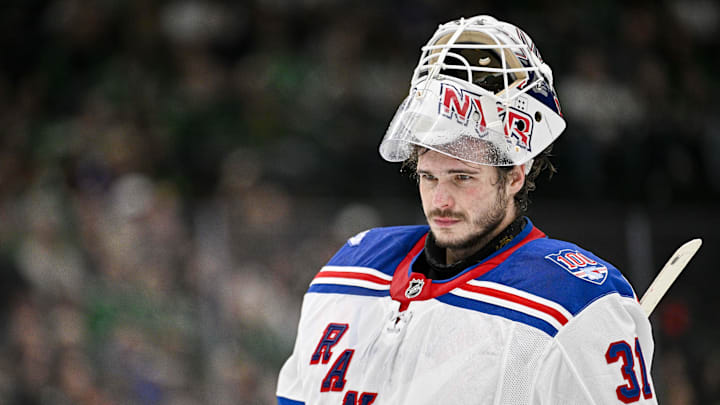
The NHL has officially announced the three finalists for this year's Vezina Trophy, and to the surprise of no one, Igor Shesterkin was not one of them. Unlike the majority of year-end honors, the Vezina is one of the few awards not decided by the PHWA. Instead, the league's general managers cast the ballots to crown the NHL's top netminder.
Historically, the two metrics most vital to that voting pool are total wins and playoff qualification, two areas where Shesterkin, through little fault of his own, fell flat in a transitional season for the Rangers. But if you expand the scope and stack Shesterkin’s analytical profile against those who were chosen, it becomes clear that the Blueshirts' ace remains among the true elite in the league.
Here are the Vezina Trophy finalists! 🏆 #NHLAwards
— NHL (@NHL) April 29, 2026
The Trophy is awarded annually to the League’s top goaltender. pic.twitter.com/gr63RtHzAy
Shesterkin was better than most people realize
Before diving into the advanced metrics, it’s important to recognize that Igor wasn't the only elite netminder on the outside looking in. This year’s snub list is particularly crowded, featuring Scott Wedgewood (31-6-6, 2.02 GAA, .921 SV%) and Logan Thompson (31-21-6, 2.44 GAA, .912 SV%), two players who arguably had finalist-caliber resumes of their own.
Wedgewood and the Colorado Avalanche got off to a blistering start, but they hit the skids in January as both the team and the goalie underwent some expected regression. His candidacy likely suffered from the platoon narrative, winning the Jennings Trophy alongside Mackenzie Blackwood, because playing only 45 games often makes it difficult to sway general managers who value a true workhorse.
Logan Thompson, meanwhile, was the primary reason a struggling Washington Capitals squad stayed afloat for as long as they did. His .912 save percentage was identical to Shesterkin’s, and his 31 wins were a testament to his durability. If I had to guess, the general managers prioritized Ilya Sorokin for the final spot because of his sheer workload and the Hart Trophy narrative he carried for much of the winter. The fact that the Islanders hung around the playoff race until the final week likely gave Sorokin the edge over netminders on teams that had already faded.
What the numbers say about finalists and snubs
Now we can get into Igor's number in context of the finalists.
- Andrei Vasilevskiy: 39-15-4, 2.31 goals against average, .912 save perentage
- Ilya Sorokin: 29-24-2, 2.68 goals against average, .906 save percentage
- Jeremy Swayman: 31-18-4, 2.71 goals against average, .908 save percentage
On the surface, Shesterkin’s 25-19-6 record makes him look like a bystander in this year’s race. However, a deeper look reveals a performance that was arguably more efficient than those of the finalists. Shesterkin ended the season with a 2.50 GAA and a .912 SV%... marks that were actually superior to both Sorokin and Swayman. While he won four fewer games than Sorokin and six fewer than Swayman, the efficiency gap is impossible to ignore.
The conversation gets even more interesting when you dig into the underlying metrics. According to Evolving-Hockey, Shesterkin graded out as a top-tier performer alongside Thompson and Swayman. In terms of Goals Saved Above Average (GSAA), the top three netminders in the league were Thompson (26.28), Wedgewood (25.84), and Shesterkin (22.4). For comparison, finalist Andrei Vasilevskiy sat in fourth (20.75), while Swayman (6th, 17.65) and Sorokin (9th, 15.49) trailed significantly.
Goalie | GSAA (Rank) | GSAx (Rank) | Games Played |
|---|---|---|---|
Logan Thompson | 26.28 (1st) | 61.32 (1st) | 58 |
Scott Wedgewood | 25.84 (2nd) | 32.42 (7th) | 45 |
Igor Shesterkin | 22.40 (3rd) | 35.54 (5th) | 51 |
Andrei Vasilevskiy | 20.75 (4th) | 39.93 (4th) | 58 |
Jeremy Swayman | 17.65 (6th) | 52.27 (3rd) | 55 |
Ilya Sorokin | 15.49 (9th) | 52.29 (2nd) | 55 |
When you look at Goals Saved Above Expected (GSAx), a similar elite group emerges. Thompson, Sorokin, and Swayman occupied the top three spots, largely because they faced a higher volume of high-danger chances. While Vasilevskiy and Shesterkin technically had easier workloads by comparison, Shesterkin still finished fifth in the NHL with a 35.54 GSAx.
When looking at the totality of the numbers, tied for fourth in save percentage, seventh in GAA, third in GSAA, and fifth in GSAx, you see an elite profile. If not for the January injury that cost him nearly a month of action, Shesterkin likely would have had the win totals necessary to force the general managers to look past the Rangers retool status.
While I expect Shesterkin to finish somewhere around sixth or seventh in the final voting, this season serves as a reminder that even in a down year for the organization, Igor remains the gold standard more than worth his $12.5 million salary.
 Add us as a preferred source on Google