

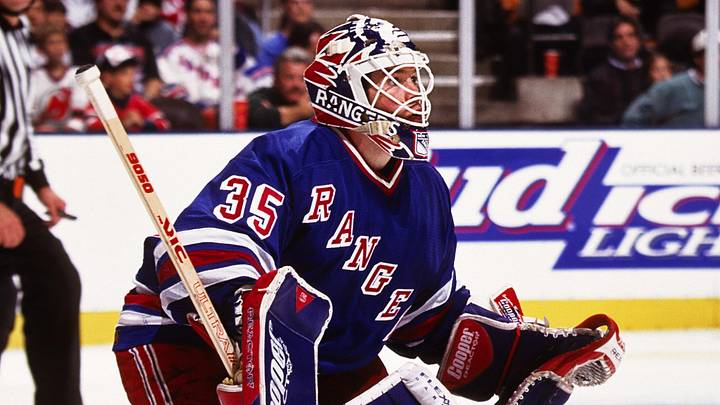
The 2026 Hockey Hall of Fame class was announced on Monday, and the latest news is something that should open the door for a New York Rangers legend to have their candidacy reevaluated. When a player remains on the outside looking in, it is always tricky to lobby for their induction. Nothing has changed about their career, and logic would dictate that if they were unworthy in their first few years of eligibility that it was just never going to happen for them. But with the news that Pekka Rinne is headed for enshrinement in Toronto, Mike Richter's case deserves another look.
Richter is an unsung goaltender who unfortunately had his career cut short
If Richter hadn't suffered a career-ending injury at age 36, there's a decent chance he'd have earned enough wins to boost his candidacy. He ended with 301 regular season wins and 41 playoff wins, and it is fair to say that injuries robbed him of at least 50 more wins. That he finished with that amount of wins could be enough for the committee to not look at his case any further.
Richter's career line also features a 2.89 goals against average and a .904 save percentage in the regular season, and a 2.68 goals against average and a .909 save percentage in the post season. He backstopped the Blueshirts to a Stanley Cup in 1994, and was sensational with a 2.07 goals against average and .921 save percentage during that run.
He also was spectacular for the team during the 1996-97 playoffs in which they went to the Eastern Conference Final against Philadelphia. That year he posted a 2.11 goals against average and a .932 save percentage. He never won a Vezina trophy, and winning at least one of those would have helped his case. There's other factors worth considering, and given Rinne's recent selection, the committee should look at Richter's case a little more closely.
How Richter stacks up to Rinne
Rinne ended his career with 369 wins in 63 games, a 2.43 goals against average and a .917 save percentage in the regular season. That triple slash has Richter beat easily, and the Nashville Predators legend also won the Vezina Trophy in 2017-18 as the league's top netminder. He also posted a 2.49 goals against average and a .914 save percentage in 89 career playoff games.
While that certainly is something that got the attention of voters, Richter's international resume is something that shouldn't be overlooked. Richter backstopped Team USA to gold at the 1996 World Cup of Hockey, and he was also named tournament MVP. He also backstopped Team USA to silver at the 1992 Canada Cup, and the 2002 Winter Olympics at Salt Lake City. Richter inspired a generation of young American goalies, and his legacy is remembered to this day in college hockey with the Mike Richter award which goes to the most outstanding goaltender in men's hockey.
Rinne's claim to fame internationally was a silver medal at the IIHF World Championships, where he was also tournament MVP, but he never won an Olympic medal with Finland. Lack of participation from the NHL post the Sochi games didn't help matters, but it is still a point worth mentioning.
Rinne's induction could open the door for other netminders
While Richter's case certainly deserves another look, it is hard to imagine him getting in before someone like Chris Osgood, and that's if he even gets considered at all. Osgood won 401 games, had a 2.49 goals against average, a .905 save percentage in the regular season, and won three Stanley Cups.
Osgood was the backup for the 1996-97 run, the starter for the 1997-98 Cup, and started for Detroit again as a 35 year old in 2007-08. He also held down the fort a year later, and posted a 2.01 goals against average and .926 save percentage in which the Wings almost went back to back again.
Osgood undoubtedly deserves consideration now that Rinne's in, and so too does Richter. It may take more years for that to happen, given the nature in which the Hall of Fame likes to space out goalie inductions, but it still remains a topic worth talking about.
 Add us as a preferred source on Google