

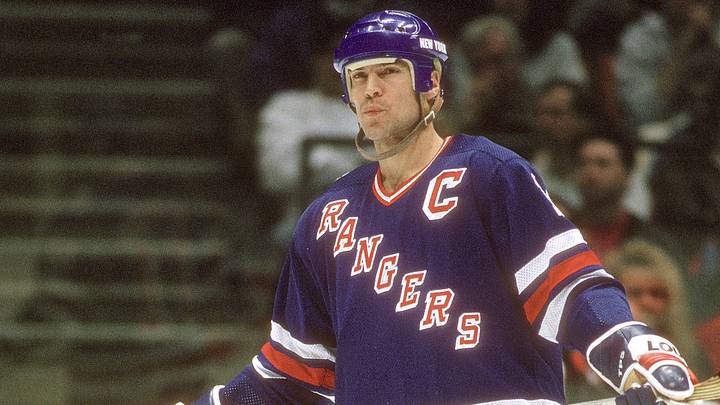
We are firmly in the dog days of August, and with a few more days to go until the calendar flips to September, I decided it was fine time to do some more "remembering" A little while ago I reflected back on Jaromír Jágr's historic year, and when looking back at the numbers for that story I noticed something that deserved some extra attention. Mark Messier's number 11 is retired, primarily for his efforts in 1994, but I think many overlook what was truly his best season as a Blueshirt. Part of that could be because of what happened in the playoffs, but it is still worth looking back on.
1991-92 was a historic year for the Rangers
The New York Rangers finished with the best record in the NHL during the 1991-92 season, and it was the first time they'd ever won the Presidents' Trophy. Messier was a big reason why they won the trophy, and his arrival in the organization was something that happened very last minute.
Messier was the Oilers' best player after Wayne Gretzky was traded to the Los Angeles Kings, and he won his final cup with them in 1990 as the captain. He was the league MVP this year as well, and even though he was under contract for a few more years, Messier tried to negotiate a new deal with Glen Sather.
He was also frustrated with the overall trend of the Oilers losing good players, first Gretzky, and later on Adam Graves. This frustration essentially led the Messier asking out, and he eventually got his wish on October 4, 1991. Messier went to the Rangers in exchange for Bernie Nichols, Louis DeBrusk, and Steven Rice.
Messier's best season was his first
Statistically speaking, the 1991-92 season was his best on Broadway. Messier joined the Rangers and scored 35 goals. he recorded 72 assists, and finished with 107 points in 79 games played. This was just two points short of Jean Ratelle's 109-point campaign during the 1971-72 season which stood as the Rangers' team record at the time.
New York ended the season with a record of 50-25-5, they scored the third-most goals with 321, and surrendered the fourth fewest at 246. Despite opening the season at +2500 odds to win the Stanley Cup, there was a lot of optimism around the squad to make a push to end the drought that stretched back to 1940.
Messier's efforts which led to him winning the Hart Trophy as top player, and the Lester B. Pearson trophy as top player as voted upon by the NHLPA wasn't the only fire power driving the Rangers. Brian Leetch finished with 102 points and captured the Norris Trophy as the league's top defenseman, and Mike Gartner had 40 goals and 41 assists for 81 points in 76 games. You also had James Patrick contribute 71 points as a defenseman, and 21 year old Tony Amonte added in 69 points for good measure.
Rangers' run shorter than expected
The Rangers were taken to seven games in the first round of the playoffs vs. the New Jersey Devils, and rallied from a 1-2 hole to make it a 3-2 series before losing Game 6 to force a pivotal Game 7. That was an easy win for the Rangers as they defeated New Jersey 8 to 4.
The following round was against the eventual Stanley Cup champion Pittsburgh Penguins, and saw the Blueshirts lose in six games. The Penguins and Rangers traded 4-2 wins in Games 1 and 2, traded overtime wins in Games 3 and 4, and then the Penguins won Game 5 3-2, and Game 6 5-1.
Ron Francis had 12 points in the series, Kevin Stevens had nine, and future Blueshirt Jaromír Jágr had seven. Interestingly enough, the Game 4 loss to the Rangers was Pittsburgh's last of the playoffs as they swept the Boston Bruins and Chicago Blackhawks in the Conference Final and Stanley Cup Final.
What happened the following year laid the groundwork for 1994
The Rangers' season ended in a disappointment, but their success led to optimism for the 1992-93 season. Unfortunately for them, that was short-lived. The Rangers missed the playoffs and finished with a 34-39-11 record and 79 points.
Roger Neilson ended up getting fired, and Ron Smith ended the season as head coach with a 15-22-7 record. Leetch appeared in just 36 games that season, and Sergei Zubov was limited to 49.
While that season was viewed as a disaster, especially in light of what they did the year before, everyone knows how things went in 1994. That said, everything got started by Messier joining the Rangers in 1991, having an electric 107 point season which almost set a new team record, and one that also saw him capture two trophies.
Everyone will remember him for his accolades in the cup winning season, but 1991-92 was certainly a year for the
 Add us as a preferred source on Google