

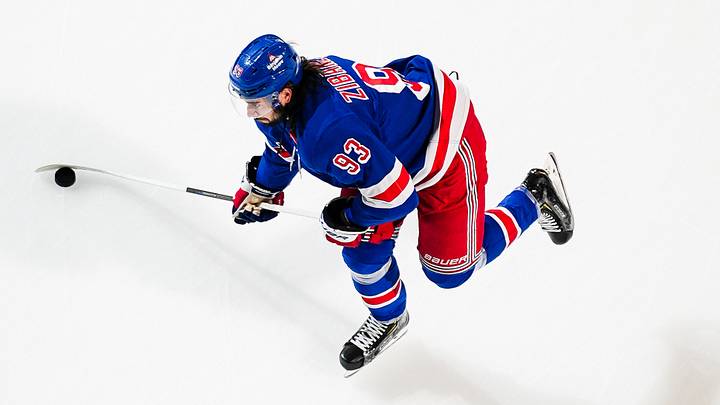
Mika Zibanejad’s career-low shot generation has become a glaring concern for a New York Rangers offense searching for consistent goal production. Through 19 games this season, the 33-year-old center has managed just three goals, translating to an average of 0.16 goals per game, the lowest scoring rate of his 16-year NHL career.
The only other time Zibanejad’s goal-scoring rate dipped this low was his age-19 rookie season with the Ottawa Senators in 2012-13, when he posted a 0.17 mark. In every other campaign since, he has cleared at least 0.23 goals per game, peaking at an elite 0.72 clip during his 41-goal outburst across 57 games in 2019-20.
To be fair, Zibanejad has recorded 13 assists, and his 0.68 assists per game rate represents a career high. Not everything about his play has declined. At his core, however, Zibanejad is a natural goal scorer, and right now, he simply isn't looking to shoot the puck. J.T. Miller was quick to own his recent scoring woes following the team's most recent loss against Edmonton, and it was only fair to take a look into someone else in the same boat.
Zibanejad’s Shot Generation Has Cratered
Throughout his tenure on Broadway, Zibanejad has averaged 2.76 shots per game, a noticeable step up from the 2.10 rate he maintained in Ottawa. This season, that volume has cratered to a career-low 1.84 shots per game, marking a steep decline from the 2.65 shots per game he generated in 2025-26.
The year-by-year numbers illustrate how dramatically his shot generation has dropped off:
Season | Games | Goals | Shots | Shots Per Game |
|---|---|---|---|---|
2016-17 | 56 | 14 | 119 | 2.13 |
2017-18 | 72 | 27 | 212 | 2.94 |
2018-19 | 82 | 30 | 236 | 2.88 |
2019-20 | 57 | 41 | 208 | 3.65 |
2020-21 | 56 | 24 | 171 | 3.05 |
2021-22 | 81 | 29 | 219 | 2.70 |
2022-23 | 82 | 39 | 251 | 3.06 |
2023-24 | 81 | 26 | 221 | 2.73 |
2024-25 | 82 | 20 | 183 | 2.23 |
2025-26 | 81 | 34 | 215 | 2.65 |
2026-27 | 19 | 3 | 35 | 1.84 |
As Zibanejad has matured, his role has shifted toward setting up teammates. His linemate Alexis Lafrenière has proved that a top-line forward can do both. Sharing top-unit minutes with Zibanejad hasn't stopped Lafrenière from posting nine goals, nine assists, and 18 points in 19 games to lead the Rangers in goals and rank second in scoring.
Zibanejad’s 13 assists rank second on the roster, and his 16 points place him third. He remains an effective playmaker, but his declining shot volume leaves the team vulnerable. He could stand to play with far more attacking urgency.
There has also been an element of bad luck. Zibanejad has registered just one goal at 5v5, one on the power play, and one shorthanded. As the franchise's all-time power-play goal leader with 125 career PPGs, surpassing Camille Henry and Chris Kreider, you expect those tallies to come, though some stagnation is natural with a new-look top unit building chemistry.

Even at even strength, Zibanejad has two dynamic playmakers in Lafrenière and Gabe Perreault feeding him pucks. Rangers fans frequently joke about the team overpassing in search of the perfect play, but that tendency has become an active detriment for Zibanejad. It's a weird development too, especially considering that he still has a howitzer of a shot.
Per NHL EDGE data, Zibanejad's hardest shot this season has been 93.34 MPH, and that places him in the 97th percentile. It represents a dip from last year's high of 96.39 MPH which put him in the 98th percentile, but it is still one of the league's best.
Heading into game 20 of an 84-game schedule, the Rangers are nearing the official quarter mark of the season. Zibanejad remains an effective 5v5 driver with a 52.37 GF%, a 46.41 CF%, and a 55.02 xGF%. Nobody is suggesting he become a selfish puck hog, but by stepping back as a shooter, he has made New York's offensive attack predictable. Pulling the trigger more often would lift his own numbers and open up ice for everyone else.
 Add us as a preferred source on Google