

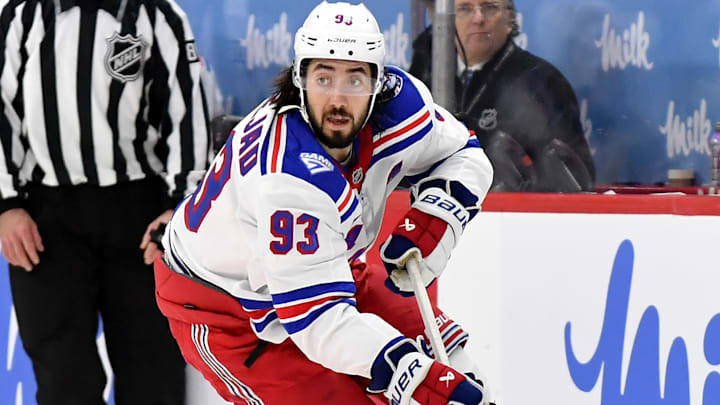
Before the start of this season, Mike Sullivan made a conscientious effort to visit Mika Zibanejad at his home in Stockholm, Sweden. He went there to get to know Mika on his home turf, to immediately break down barriers between coach and player, and to connect on a human level. Sullivan understood he was stepping into a situation where his number one center had been much maligned, and he wanted to dispel any rumors about Mika’s future with the team. Part of the visit was also to gauge Mika’s interest in starting the season on the wing.
Sullivan’s hands-on approach to building team chemistry was evident right away. He knew his first major step had to be getting on the same page with Zibanejad. Mika, who cares deeply about playing his best, wears his heart on his sleeve and doesn’t compartmentalize the emotions of such an intense sport. Last season, his trademark infectious smile was rarely seen, replaced by a dejected temperament that showed both on the ice and in post-game interviews.
It’s clear that Sullivan’s meeting with Mika went a long way toward building the trust and relationship needed between the team’s top players and their new head coach. This season, Mika has alternated between being the number one center and the first-line winger to accommodate J.T. Miller’s presence. To his credit, he’s embraced every role the coaches have asked of him without complacency or resistance.
For argument’s sake, though, Mika is the Rangers’ true number one center
His role is integral. He anchors both the top penalty-killing and power-play units, while averaging the most ice time (20:30) among the team’s forwards. His imprint is everywhere. When he’s hot, the Rangers look unbeatable; when he’s not, they become far easier to play against.
Mika is experiencing a resurgence not only on the ice but mentally as well. He’s more confident, more physical, and his compete level in all three zones is noticeable attributes that can be credited to Sullivan’s influence. With 24 points in his first 31 games, Mika is scoring at essentially the same rate as last season. Yet this year feels different. He’s more physically engaged, battling harder, and most importantly, no longer relying solely on his trademark left-circle one-timer. That shot has become just one weapon in his offensive arsenal, not his crutch.

This season, Mika is scoring in a variety of ways. He’s at his best when his play is improvisational rather than calculated and predictable. He has always been the Rangers’ ace in the hole, but early signs suggest Sullivan has unlocked something inside him that’s driving him to become a more complete player.
If Mika can sustain this momentum and fully embrace Sullivan’s system, the Rangers will reap enormous benefits. Make no mistake: Mika is the mirror of this team. He is the precise difference between the Rangers being elite or merely good.
So, here’s to getting that Mika smile back. Ranger’s fans know one thing for certain—the more he smiles, the better things are in Rangers Town.
 Add us as a preferred source on Google