

The New York Rangers entered last season believing their high-end talent could carry them into the playoffs. Instead, a litany of problems gradually eroded those expectations. Injuries to Adam Fox and Igor Shesterkin exposed the roster’s fragile underpinnings, while dismal five-on-five scoring compounded the problem. The struggles were especially pronounced at Madison Square Garden, where the Rangers were blanked in five of their first seven home contests. The Blueshirts eventually spiraled to the bottom of the Eastern Conference and launched a significant retool.
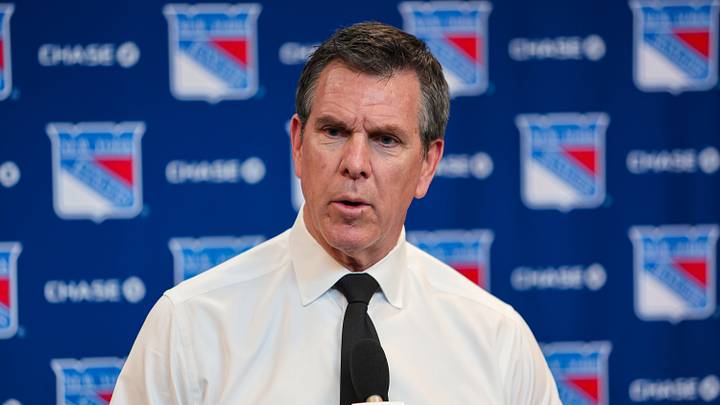
Greater organizational depth became an underpinning of Chris Drury’s offseason plan, and the general manager was forthright about why. Both Drury and head coach Mike Sullivan repeatedly returned to last season’s inability to withstand injuries during their opening training camp media availability. Drury believes the Rangers checked most, if not all, of their offseason boxes, while Sullivan expects a deeper roster to make New York more competitive and better equipped to withstand adversity. From the organization’s renewed emphasis on depth to No. 5 overall pick Alberts Šmits’ legitimate opportunity to make the team and a complicated backup-goaltending competition, here are the biggest takeaways as Rangers training camp gets underway.
Rangers believe their offseason additions created needed depth
The Rangers’ offseason was not defined by one singular, transformative addition. Instead, Drury augmented nearly every layer of the roster, adding options to the top six, bottom six, blue line, and backup goaltending slot.
Pavel Dorofeyev was the biggest addition. The 25-year-old scored a career-high 37 goals last season, including 20 on the power play, before adding 12 more during Vegas’ run to the Stanley Cup Final. The Blueshirts also signed six-time 20-goal scorer Oliver Bjorkstrand to provide a dependable middle-six option. Drury added Joe Veleno, whose speed, physicality, faceoff ability, and penalty-killing experience should strengthen the bottom six.
New York also reconstructed its defense. Vincent Trocheck was sent to Utah for puck-moving defenseman Sean Durzi, prospect Cole Beaudoin, and a 2027 third-round pick. The Rangers then replaced Will Borgen with Marcus Pettersson, a durable top-four, left-shot defenseman who has averaged more than 21 minutes per game in each of the past three seasons.
Behind Shesterkin, Drury acquired Joonas Korpisalo to compete with Dylan Garand and provide an experienced option if the Rangers again lose their starting goaltender for an extended stretch. Veterans Dennis Cholowski and Glenn Gawdin were also signed to strengthen Hartford and provide additional organizational call-up options.
Drury was forthright about the motivation behind those moves. “I feel like we checked most of [what we wanted to do], if not all of them,” the GM said. “I think when we were healthy last year, our record was pretty good. When we weren’t healthy, it was not good. We didn’t have the depth to support missing those big pieces in the lineup.” What Drury has tried to build is a roster replete with legitimate contingency plans, one that won't let a single injury force multiple players into roles they are ill-equipped to handle. Sullivan shares that optimism, although he stopped short of making any grand declarations.
#NYR GM Chris Drury and head coach Mike Sullivan both feel the team's depth is greatly improved.
— Mollie Walker (@MollieeWalkerr) September 16, 2026
"I feel like we checked most of [what we wanted to do], if not all of them," Drury said. "I think when we were healthy last year, our record was pretty good. When we weren't healthy,…
“My expectation is that we’re going to compete,” Sullivan said. “I think we have more depth than we had a year ago. I’m hopeful that our team can stay a little bit healthier this year, which should help us.”
Training camp will provide the first barometer of whether those moves have actually produced a deeper team. Yet compared with last season, Sullivan enters camp with significantly more legitimate options and considerably more difficult decisions.
Backup-goalie competition presents Rangers with difficult decision
Shesterkin’s position is secure. The identity of the goaltender behind him is anything but settled.
Dylan Garand appeared ready to inherit the backup role after finishing last season with an impressive three-game NHL audition. The 24-year-old went 2-0-1 with a 1.62 goals-against average, a .948 save percentage and 3.9 goals saved above expected.
However, rather than simply hand him the job, Drury acquired Korpisalo from the Boston Bruins for forward prospect Kalle Väisänen and a 2028 fourth-round pick. The Rangers will carry $3 million of Korpisalo’s cap hit in each of the next two seasons.
“‘Korpy’ is a guy that I think is a bona fide NHL goalie that’s had success and has a body of work in this league that shows that he can be an effective goaltender, especially at the backup position,” Sullivan said.
Korpisalo has appeared in 334 NHL games, although his recent numbers leave the competition open. He finished last season with a 14-9-6 record, a 3.15 goals-against average and an .894 save percentage. Sullivan also made it clear that Garand’s late-season performance earned the organization’s attention.
“He showed us late in the season last year that he’s very capable of making saves in this league,” Sullivan said. “His overall growth and development have given us a little bit more legitimate depth at the goaltending position.”
All I ask is if that Garand outplays Korpisalo, that Garand wins the back up goaltending job
— NYR Louie ™️ (@NYRLouie) September 15, 2026
And not to give Korpisalo a curve because you traded assets for him or because he gets paid more
I want a meritocracy #NYR https://t.co/Vi6OQysXsv
The quandary extends beyond determining which goaltender performs better during camp. Garand would have to clear waivers to return to Hartford, meaning the Rangers could lose a promising 24-year-old for nothing if they choose Korpisalo. Carrying three goaltenders would protect the asset but create complications elsewhere on the roster.
With the schedule expanding to 84 games, the winner could receive approximately 25 to 30 starts behind Shesterkin. That makes the decision more consequential than a typical backup battle, and the condensed preseason gives Sullivan little time to settle it.
What is #NYR head coach Mike Sullivan looking for when deciding who will be backup goalie?
— Mollie Walker (@MollieeWalkerr) September 16, 2026
"I think Chris spoke about adding depth to our organization in a number of different positions. Well, the goaltending position is one. I think that we've added for different reasons. I…
“The best teams have healthy competition, and it makes decisions for the general manager and the head coach difficult,” Sullivan said. “I think our goaltender position is at that point right now.”
Garand may have ostensibly entered camp as the incumbent, but Korpisalo’s experience and contractual commitment ensure that neither goaltender will be handed the position. The competition will serve as an early barometer of whether the Blueshirts newfound depth produces better results or merely more difficult decisions.
Alberts Šmits has a legitimate chance to make the Rangers
The No. 5 overall pick arrives with more experience against older competition than the typical 18-year-old. Šmits has already played professionally in Europe and competed at the 2026 Milan-Cortina Olympics, while his size, skating, and physical edge made him one of the most NHL-ready defensemen in his draft class. Still, the Rangers don’t intend to rush him simply because they would like him in their lineup sooner rather than later.
“In the big picture, the sooner that Šmits becomes part of our roster, the better,” Sullivan said. “But we also have to make sure that we do the right thing for him, both in the short term and in the long term.”
His first Rookie Series appearance illustrated both sides of the evaluation. Šmits recorded two power-play assists and used his strength effectively against older Philadelphia Flyers prospects. Still, he was also on the ice for all three goals against and struggled with his puck management, particularly early in the tilt.
Does Alberts Šmits have a chance to make the Rangers?
— Peter Baugh (@Peter_Baugh) September 16, 2026
Mike Sullivan: "Yes, he has a chance to make the team."
Those mistakes don’t eliminate his opportunity. They establish what the Blueshirts must evaluate during a condensed camp: whether Šmits’ physical maturity and two-way tools already outweigh the inevitable growing pains of an 18-year-old defenseman.
“His play will tell us where we think he fits and what’s best for him,” Sullivan said. The organization clearly envisions Šmits becoming part of their NHL defense soon. The next several weeks will determine whether that future begins on opening night.
 Add us as a preferred source on Google