

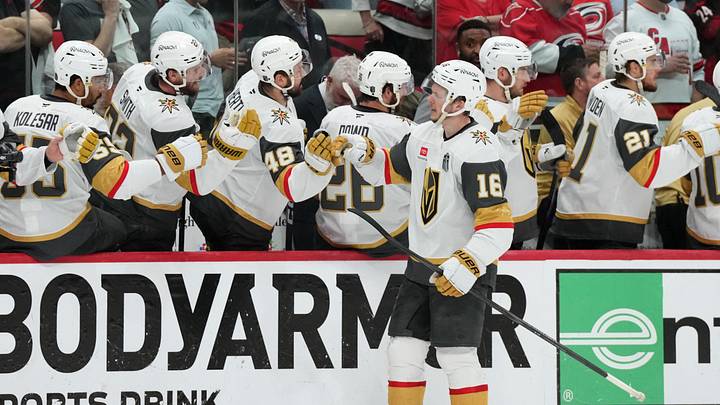
What happens when you push your chips to the middle of the ice for a 25-year-old sniper? Chris Drury is about to find out. The New York Rangers didn't just acquire Pavel Dorofeyev. They backed up the Brinks truck with a seven-year, $77 million commitment. That's a whole lot of faith in a player coming off consecutive 35+ goal seasons. Now comes the fun part: figuring out whether he hit the bullseye.
Dorofeyev has buried 72 goals over the last two seasons, establishing himself as one of the NHL's most dangerous young finishers. Last season alone, he lit the lamp 37 times while posting 64 points across all 82 games, then showed that his scoring touch didn't disappear when the ice got tighter. He added another 12 goals in 22 playoff games during Vegas' run to the Stanley Cup Final.
That's the type of production the Blueshirts badly needed after moving on from Artemi Panarin. Yet, there's also a pretty significant difference between needing a goal scorer and handing one $77 million. So, was Dorofeyev simply the beneficiary of playing in a loaded Vegas offense, or did Drury just acquire one of the league's next premier snipers?
Numbers suggest Dorofeyev's scoring is no mirage
The goals are great, but the statistical underpinnings of Dorofeyev's breakout year are more encouraging for the Blueshirts. Dorofeyev didn't stumble his way into 37 goals. His shot profile was replete with the type of chances that typically breed sustainable scoring. He ranked in the 95th percentile among NHL forwards in high-danger shots on goal while also landing in the 90th percentile in high-danger goals. He was equally dangerous from farther out, ranking in the 93rd percentile in both midrange shots and midrange goals.
The @NYRangers were looking for goalscoring, so they acquired Pavel Dorofeyev from the Golden Knights.
— NHL Media (@NHLMedia) August 26, 2026
Will the back-to-back 30-goal scorer replicate his past performances in the Big Apple? 🤔
📺: #NHLTonight on NHL Network pic.twitter.com/ap4oBf3lN3
The Rangers aren't paying $77 million for a player who simply rode an unsustainable shooting percentage for one season. Dorofeyev consistently found dangerous ice and, more importantly, showed an innate ability to finish once he got there. In fact, the 25 year-old was one of only four NHL players to score at least 10 goals on wrist shots, 10 on snap shots, five on slap shots, and three on backhands. The other three? Nathan MacKinnon, Nikita Kucherov, and Steven Stamkos.
However, one number threatens to undermine some of that optimism. Twenty of Dorofeyev's 37 goals came on the power play. That's more than half of his production coming with an extra skater while playing in a loaded Vegas offense. So while the underlying numbers paint the picture of a premier finisher, they also raise the next question the Rangers must answer: how much of the left-winger's success was intrinsic, and how much was a product of the environment around him?
Can Dorofeyev produce without Vegas' star-studded supporting cast?

For all the tantalizing numbers, there is a Golden Knight-sized elephant in the room. Dorofeyev wasn't playing with a gaggle of fourth-liners in Vegas. Jack Eichel, Mitch Marner, Mark Stone and Tomas Hertl surrounded him on a loaded top power-play unit, and Dorofeyev took full advantage. Eichel's fingerprints were particularly prevalent. The star center assisted on 10 of Dorofeyev's regular-season goals before helping set up eight of his 12 tallies during Vegas' run to the Stanley Cup Final. Over the last two seasons, the duo controlled 62.2% of the expected goals at five-on-five when they shared the ice.
Last season alone, that number was 67.2%. But what happened when Dorofeyev had to fend for himself? That's where the "product of Vegas" label begins to lose some of its luster. The Russian spent 1,922 minutes apart from Eichel and still posted a 55.7% expected-goal share. Jack may have augmented Dorofeyev's game, but he didn't manufacture it. The same applies to Mitch Marner. Pavel posted a 57.3% expected-goal share alongside him last season and a 56.5% mark without him. The superstar talent surrounding Dorofeyev certainly helped raise his ceiling, but the floor underneath him remained remarkably sturdy.
Of course, proving he could thrive away from Vegas' stars is only half the equation. Someone still has to feed the sniper in New York.
Who will help unlock Dorofeyev on Broadway?
Coach Mike Sullivan hasn't hidden the blueprint. "He's a scorer, and he needs somebody to get him the puck." The Rangers have two intriguing candidates for the job. Mika Zibanejad might offer the closest parallel to the partnership Dorofeyev is leaving behind. Like Eichel, he's a right-handed center who can distribute the puck while presenting a shooting threat of his own.
Dorofeyev also found success alongside left-handed center Tomas Hertl in Vegas, who assisted on eight of his regular-season goals and four more in the postseason. That's a role captain J.T Miller can fill because of his ability to win battles and create opportunities for a winger whose greatest weapon is when someone else puts the puck on his tape. Sullivan doesn't need to recreate Vegas. He needs to put Dorofeyev in positions where he can do what he does best.
PAVEL DOROFEYEV CALLS GAME 🚨
— NHL (@NHL) May 13, 2026
VEGAS WINS GAME 5 IN @ENERGIZER OVERTIME! #StanleyCup pic.twitter.com/BiAoEew6PZ
The power play, however, might offer less ambiguity. Dorofeyev spent time in the offensive zone on the man advantage last season. His 65.4% power-play offensive-zone time ranked fourth in the NHL. Conveniently, he's walking into a Rangers unit that finished second in that same category at 61.3%. And Adam Fox is waiting at the blue line. The 2021 Norris Trophy winner led all NHL defensemen with a 64.2% power-play offensive-zone time percentage last season.
Despite being limited to 55 games, he still produced 24 power-play points, and his 137 power-play points over the last five seasons trail only Cale Makar and Quinn Hughes among defensemen. Vegas gave Dorofeyev a man-advantage capable of establishing possession and repeatedly funneling pucks toward one of hockey's most dangerous finishers. The names will be different in New York, but the infrastructure might not be as foreign as it initially appears.
Pavel Dorofeyev is more than an Artemi Panarin replacement

It would be easy to view Dorofeyev as the Rangers' $77 million answer to the goals that departed with Artemi Panarin. That undersells what Drury is attempting. Dorofeyev isn't a stopgap designed to keep an aging core afloat. At 25, he's young enough to bridge two versions of the Rangers: what's left of their previous contention window and the younger nucleus Drury is trying to build. Gabe Perreault, Alexis Lafrenière and Noah Laba are all at different stages of their development, and the Summer splash arrives as an NHL producer. He's coming off consecutive 35-goal seasons, has already shown he can produce in the postseason, and at 25 has yet to reach his prime years.
PAVEL DOROFEYEV PULLS OFF THE FORSBERG FOR AN EARLY GOAL OF THE YEAR BID 😱🚨 pic.twitter.com/bdwbqJrXxw
— Gino Hard (@GinoHard_) October 21, 2025
That's a rare combination for a team trying to retool rather than rebuild. The Rangers aren't interested in bottoming out and waiting five years for another contention window. They're attempting to stay competitive while shifting responsibility from an aging core to a younger one. Dorofeyev can be part of both eras. However, a $77 million commitment over seven years means being good won't be enough. Dorofeyev needs to emerge as a franchise cornerstone. Drury pushed his chips to the middle of the ice. Now Dorofeyev has to cash them in.
 Add us as a preferred source on Google