

One of the main storylines following the New York Rangers this season was their lack of success at home at Madison Square Garden. But late this season, the Rangers played much better. Since March 27, the Rangers won five of six home games, with their lone loss coming against the Montreal Canadiens. They defeated the Chicago Blackhawks 4-1, scored a barrage of goals in an 8-1 win over the Washington Capitals, and played a role in sinking the playoff chances of the Detroit Red Wings.
On Wednesday, the Rangers faced off against the Buffalo Sabres, who already clinched their first playoff spot in 14 seasons. The Rangers actually led the Sabres 3-2 in the second period after overcoming a 2-0 deficit. But in the third period, with the game tied 3-3, the Sabres scored back-to-back goals to secure the 5-3 win.
That third period? The Rangers only had one shot on goal. You read that correctly. Just one shot on goal. Against a playoff team. You are going to lose games doing that.
Mike Sullivan, J.T. Miller discuss Rangers putting up one shot on goal in third period vs. Sabres
After the game, Rangers captain J.T. Miller was asked how the team only managed one shot on goal in the final 20 minutes of game time.
"I don’t know if we sat back a little too much with the lead, but we had a couple good shifts to start the period, didn’t get anything on net, and they kind of controlled the play there through the middle part. And then we pushed again at the end. That’s obviously not good enough," said Miller, h/t Mollie Walker of the New York Post.
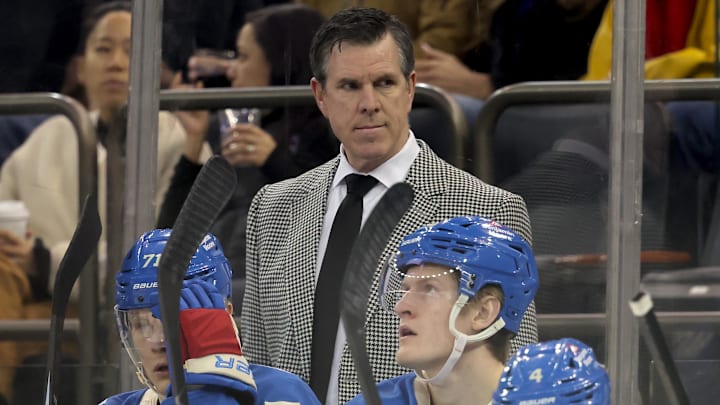
Rangers head coach Mike Sullivan also touched on the lack of shots on goal in the third period. The coach said he didn't see the team not exhibiting effort in the final 20 minutes. Rather, he wishes the team would shoot the puck more instead of looking for the next play.
"Oh it wasn't a lack of effort," said Sullivan. I thought we had opportunities. I wish we'd shoot the puck more. I feel like we pass up opportunities. There was a couple of them where we're in Grade A ice and we choose to try to look for the next play, and it doesn't get to the net. I'm not sure that was a reflection of how the period was played."
If there is one thing that Rangers fans know, it's that sometimes, they are looking to set up the next play rather than shooting the puck on net. It becomes amplified when the team is on the power play. As a result of what happened on Wednesday, you get one shot on goal against a team competing for the Atlantic Division title.
The Rangers played a dangerous game, as the Sabres are one of the most top scoring teams in the league, averaging 3.42 goals scored per game (seventh-best in NHL). The Sabres also average 28.3 shots per game (tied for 12th-best in NHL). It was only a matter of time until two of the Sabres' eight shots in the third period hit the back of the net.
The Rangers rebounded quite nicely at home, as evidenced by their five wins in a seven game home stand. Let's not forget how dire things were for the Rangers. On March 5, in their 6-2 win over the Toronto Maple Leafs, it was their first victory in regulation at home since Nov. 24 against the St. Louis Blues. The Rangers are 14-20-7 at home this season.
Considering this was the Rangers' final home game of the season, it would have been something had they been able to pull off another upset win against a top team. Alas, a one-shot third period sunk those chances.
 Add us as a preferred source on Google