

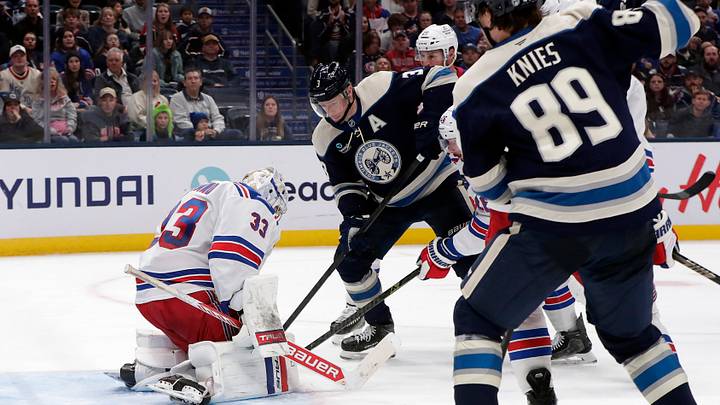
The New York Rangers responded Saturday night. They defended with greater urgency. They managed the puck more responsibly. Their penalty kill remained outstanding, and Dylan Garand looked nothing like the young goalie pulled during Thursday’s 7–1 nightmare against the New Jersey Devils. Yet the Rangers still left Nationwide Arena with a 1–0 overtime loss to the Columbus Blue Jackets because their response addressed everything except their most pressing concern: creating offense. Kent Johnson finally ended the scoreless stalemate 3:26 into overtime, hammering Zach Werenski’s cross-ice feed past Garand from above the right circle. Jet Greaves stopped all 29 of the visitors' shots, while Garand made 28 saves of his own as New York fell to 6–3–1.
A response, but only on one side of the puck
Captain J.T. Miller called Saturday’s tilt a “good response” and described three-on-three overtime as something of a toss-up. He is partly right. After completely unraveling against New Jersey, the Blueshirts returned to the connected, defensively committed style that powered their strong start. They protected the middle, blocked shots and avoided the avalanche of catastrophic mistakes that buried them across the Hudson. Dylan Garand supplied the rest.
He stopped Adam Fantilli multiple times, robbed Cole Sillinger with his skate late in regulation and denied Sean Monahan during Columbus’ four-on-three power play in overtime. He gave New York every chance to steal two points through his 28 save, 2.33 goals saved above expected performance, more importantly, it showed that one brutal start didn't destroy his confidence.
Garand with the nice save. He needed this one to forget about last game. #NYR pic.twitter.com/fnZqoNUAfJ
— David 🏒 (@DaveyUpper) October 17, 2026
That matters immensely with Igor Shesterkin sidelined for the season. Garand does not need to become Shesterkin. He needs to give the Rangers a chance most nights, and he did. Yet, Miller calling the entire performance a satisfying response feels incomplete. A team with internal playoff expectations cannot ask its goaltender to be perfect to have a chance against Columbus. Overtime may be unpredictable, but the Rangers had 60 regulation minutes to prevent the game from entering that territory. They never scored.
The shots did not tell the whole story
The Rangers finished with 29 shots, including six from Gabe Perreault, but too much of their possession failed to become truly dangerous offense. Perreault was active and often had the puck on his stick, yet the Blueshirts struggled to consistently turn offensive-zone time into traffic, rebounds, and second chances. That has quietly become the central question surrounding this team.
The Rangers have committed to Mike Sullivan’s aggressive, straight-ahead system. Their forecheck is more connected, their defensive structure is far stingier, and their puck support has improved. Yet possession is different from forcing the opposition into survival mode.
Right now, New York is too often establishing the zone without breaking down the defense once it gets there. They’ve gone seven consecutive periods without a five-on-five goal. The offense managed only a handful of threatening looks Saturday, even after Sullivan reunited the highly effective Tye Kartye–Miller–Pavel Dorofeyev line and moved Alexis Lafrenière alongside Mika Zibanejad and Gabe Perreault. However, when you are playing low-event hockey, the margin for error becomes microscopic. When the Rangers defend well, they can stay in virtually any game. When they fail to finish, one bounce, one penalty, or one defensive breakdown can erase 60 minutes of otherwise disciplined work.
Quality over quantity only works if the quality remains high
The Rangers' early offensive profile was unusual. They entered Saturday with a plus-14 advantage in high-danger scoring chances, generating 72 while allowing 58, according to Clear Sight Analytics. That was arguably their most encouraging team statistic. New York had been outchanced in the middle-danger areas, 47–36, and in low-danger opportunities, 104–79. The Rangers haven't tried to overwhelm teams with volume. They've conceded many of the less threatening looks and tried to win the chances that mattered most
#NYR Scoring Chances Report@NYRangers at @BlueJacketsNHL
— Stephen Valiquette (@VallysView) October 18, 2026
🏒 Data courtesy @csahockey pic.twitter.com/J8ykk8YJjb
Essentially, they were betting on quality over quantity. That approach can work. Yet, Saturday showed the danger when they possess the puck without consistently penetrating the middle. Much of New York's offensive-zone time produced one-and-done attempts, blocked lanes or looks that Greaves could see cleanly. There was not enough net-front traffic. There were not enough rebounds. Columbus didn't have enough possessions where its defensive shape completely broke down. The Rangers were around the offensive zone, but they didn't consistently get inside it. Sustained pressure can look encouraging, but unless it turns into Royal Road passes, slot chances, tips, rebounds or a greasy goal around the blue paint, it can become empty possession. Against the Blue Jackets, it did.
Jet Greaves shuts the door and picks up his first @pepsi shutout of the season! 🚪 pic.twitter.com/0CQ36qerju
— NHL (@NHL) October 18, 2026
Saturday was the Rangers' identity taken to its extreme
Entering Saturday, Blueshirts tilts averaged only 45.8 combined shots for and against per 60 minutes at five-on-five, according to Evolving-Hockey. That was the third-lowest rate in the NHL. New York averaged just 21.74 shots on goal per 60 at five-on-five, ranking 26th. The Blueshirts allowed 24.06, ranking 13th. That has been their preferred ecosystem under Sullivan. They tried to reduce the chaos, defend the middle, and trust their forecheck, with their best players available to create enough at the other end. Saturday became the most extreme version of that formula.
The Blueshirts defended well enough to earn a point. They kept Columbus off the scoreboard through three periods, killed all three Blue Jackets power plays and prevented the game from opening up. Yet, they could not generate the one finish needed to reward that structure. Low-event hockey is not automatically bad hockey. The Dallas Stars and Edmonton Oilers were the only teams with a slower combined five-on-five shot rate entering the weekend, and those three teams had a 14–7–2 record combined. The issue is what happens when a team plays that way without enough elite finishing talent.
KENT JOHNSON'S THE HERO TONIGHT 💥
— Columbus Blue Jackets (@BlueJacketsNHL) October 18, 2026
CBJ x @FanaticsSports pic.twitter.com/ovB0TgBwEg
Every missed opportunity becomes magnified. Every unsuccessful power play hurts more. One lost coverage or one east-west pass can decide the entire night. That is exactly what happened in overtime. Sean Durzi couldn't stop Columbus from getting in cleanly; Werenski found the seam, and Johnson hammered the one-timer.
The Blueshirts' true identity
The Rangers are better than they looked in New Jersey, but they probably aren't as dominant as their early goal differential suggested. This is a gritty bunch occupying the mushy middle of the NHL, likely clawing for a playoff spot come spring—which aligns realistically with the franchise's long-term reload timeline.Their defensive buy-in is legitimate. Their penalty kill is elite right now. Sullivan has installed a recognizable identity, and the team has generally responded well to his demand for connected, north-south hockey. Yet the margin is dangerously thin with a group who currently is living on the edge.
The six empty-net goals will not always be there. Lafrenière won't keep shooting 36.8 percent. Garand will not always be available to erase breakdowns. And a team already averaging near the bottom of the league in five-on-five shot volume cannot afford extended stretches in which its best forwards fail to convert. The Rangers can win playing low-event hockey. They cannot win playing no-event hockey. Saturday represented the difference.
 Add us as a preferred source on Google