

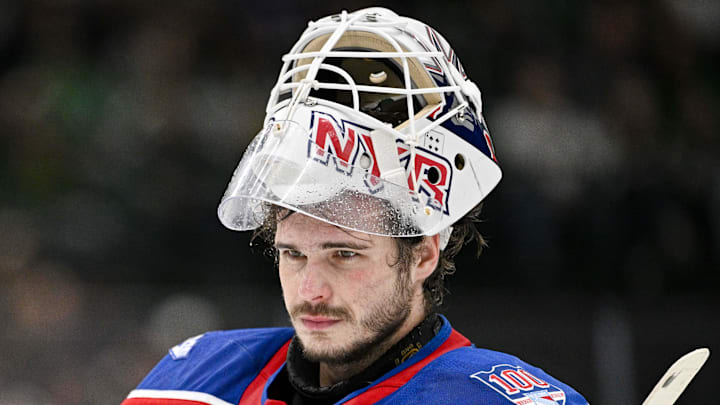
The New York Rangers season was bad. It was among the worst in team history. But it could have been much worse had it not been for Igor Shesterkin. The 30-year-old netminder kept the Blueshirts above water during the first half of the season. In fact, the Rangers were three points out of a playoff spot on January 5, when Shesterkin went down with an injury in a game against the Utah Mammoth.
The Rangers had 46 points and were still clinging to playoff hopes in a jam-packed Eastern Conference.
But no sooner did Shesterkin go down than the Rangers went into a tailspin. The rest is history.
When Sheskterkin returned to the ice following the Olympics, he actually revived the club. The Rangers went 6-4-0 in their final 10 games, with Shesterkin getting three of those wins. And in the games the Blueshirts lost, Shesterkin was fantastic. For example, New York lost a 2-0 decision to the Dallas Stars on April 11. You would have to think that if the Rangers had actually scored, they would have had a chance to win that game.
That aside, Shesterkin ended the season with solid numbers. He played in 51 games, winning 25 to go with one shutout. He had a 2.50 GAA and a .912 SV%. Had the Rangers made the playoffs, Shesterkin would be at the top of the Vezina Trophy conversation.
But since the Rangers had a dreadful season, Shesterkin shouldn’t get much consideration. Or perhaps he just might.
It’s evident that the team in front of him was awful. Even then, Shesterkin put up solid numbers. Now, imagine what numbers Shesterkin would have put up with a defense like, say, the Colorado Avalanche in front of him.
Shesterkin winning the Vezina Trophy this season would be like when Jacob DeGrom won the Cy Young for the Mets. In back-to-back amazing seasons, winning just 10 games one year. The next season, he won 11 for an underachieving Mets squad.
That’s what Shesterkin could pull off this season. If voters see performances for what they are, they would see that the Rangers' starting goalie was among the best this season. His value would be magnified even further, considering how little support he got across the board.
History not on Shesterkin’s side
Making the playoffs seems to be a prerequisite for winning the Vezina. In fact, since the Vezina criteria changed ahead of the 1981-82 season, no goalie from a non-playoff team has won the Vezina.
That does not look good for Shesterkin. If voters were to acknowledge his outstanding performance, it would be a historical achievement. By winning, Shesterkin would prove that a goalie can be the best at his position, regardless of the team in front of him.
And it makes sense. Since goalies can’t score goals (technically, they can’t), they have no control over the offensive aspect of the game. As such, a goalie can stand on his head and still lose the game. Even if a goalie earned a shutout in every game, the most he could hope for is a bunch of overtime and shootout games.
That’s why voters need to refocus their voting criteria. A team does not make the playoffs because its goalie is good. Similarly, a goalie is bad just because his team doesn’t make the postseason.
The odds are that Shesterkin won’t even be a finalist. But if there was ever a season to end that trend, it would be this one.
 Add us as a preferred source on Google