

When you talk to casual sports fans — or just doom‑scroll through Instagram comments — you start to notice a pattern. Hockey fans keep repeating the same exhausted sentiment: the NHL is terrible at marketing its own sport. And that failure isn’t just annoying; it’s actively hurting the game, its profitability, and its ability to be recognized by a wider audience.
Which is wild, because hockey should be far more popular than it is. It has the brute force of football, the athleticism of basketball, the precision of baseball, and the global appeal of soccer. It’s fast, chaotic, emotional, and visually electric. It should sell itself. Even a group of 19 NHL agents have expressed their concerns over the marketing of the NHL, to the point where they feel its "holding the NHL back". When the people paid to hype your players are begging you to do better, something is broken.
The competition is real — but that’s not the whole story
Yes, the NHL season runs from October to June, overlapping with every major sport. Yes, the American sports calendar is crowded. But that alone doesn’t explain why hockey lags so far behind in cultural relevance.
There’s a much bigger, more uncomfortable truth.
The NHL isn’t diverse enough to reach new audiences
Let’s address the elephant on the ice. The NHL does an admirable job promoting “Hockey Is For Everyone,” but the reality is that the league is overwhelmingly white. That’s not the league’s fault, nor is it the fault of underrepresented communities. It’s structural.
People connect with athletes who look like them, sound like them, and reflect their culture. The NHL simply doesn’t have the racial diversity to organically crack certain markets — and that’s largely because hockey is expensive, inaccessible, and geographically limited.
You can’t just grab a stick and play pickup hockey in most American neighborhoods. Street hockey has declined. Many outdoor rinks have been converted into soccer fields because soccer is cheaper, more popular, and more accessible.
But here’s the thing: the NHL could still overcome this if it made people want to go the extra mile to play the sport. That’s where marketing comes in — and where the league has failed immensely.
The NHL doesn’t understand modern attention
The way people consume sports is constantly evolving. What grabs attention today won’t grab attention tomorrow. Every league knows this — except the NHL, which seems to be behind every trend by at least a decade.
Stars sell the game. Personalities sell the game. Storylines sell the game.
And the NHL refuses to embrace any of that

The league loves to talk about “growing the game,” yet it markets its players like they’re interchangeable NPCs in a hockey video game. Meanwhile, other leagues lean into fashion tunnels, mic’d‑up moments, signature celebrations, and actual human expression.
When you strip away individuality, you strip away connection. Fans don’t bond with faceless uniforms. They bond with people.
The NHL still hasn’t figured that out
The league has some of the most talented athletes on the planet — and markets maybe five of them. McDavid, Crosby, Ovechkin, and the Tkachuk brothers. After that? A steep drop‑off into “did you see what Gritty did last night?”
And look, I love Gritty. I am a proud, unapologetic Gritty fan. But when the most recognizable personality in your league is a seven‑foot orange chaos muppet with googly eyes, you’ve got a branding problem.

Stagnant viewership, limited reach, and an entire generation of potential fans who couldn’t identify a single NHL player if you spotted them the jersey. You can’t grow the game when your entire marketing strategy is “hope ESPN mentions us.”
The league is out of touch with its own fans
The NHL seems genuinely confused about who its fans are, what they want, and how they consume content. It’s mind‑boggling. And while the league deserves plenty of blame, hockey culture itself plays a role.
The sport’s “team first, personality last” attitude is admirable on the ice and disastrous off it. Players are discouraged from being bold, outspoken, or charismatic. Then the league wonders why it can’t create household names.
You can’t market individuality when the culture treats individuality like an unsportsmanlike conduct penalty.
It's not all bad, there are some significant outliers in the NHL who have done a fantastic job with community outreach programs
There are several NHL organizations that have taken legitimately sincere efforts to grow the game. And they're coming from the most unlikely of places.
The Florida‑based teams have really stepped up. Both the Tampa Bay Lightning and the Florida Panthers have strong ownership and community outreach programs — the Lightning focus on diverse hockey initiatives such as sled hockey, neurodiversity camps, and youth development, while the Panthers emphasize support for veterans through Warriors Hockey, mental‑health advocacy with “Scratch the Stigma,” expanding the game in Latino communities, and unique fundraisers like “Panthers on the Prowl” for cancer research.
Another standout example is Ryan Smith, the driving force behind the Utah Mammoth and the owner of the NBA’s Utah Jazz.

Ryan Smith moves fast and thinks big, refusing to subscribe to the old, tired “slow burn” approach that so many NHL owners still cling to. The tech billionaire has rolled out a wildly successful fan‑driven branding process and a slate of community events that are fueling a statewide push to make hockey a core part of Utah’s identity.
And it was announced on January 7th that the 2027 Winter Classic is coming to Utah — in Year 3 of the franchise's existence. That doesn’t happen unless the league sees Smith as a rising star, it’s a signal: the NHL wants to ride his momentum.
Ryan Smith is not building a team; he's building a culture and other National Hockey League organizations should take note and follow his sincere lead.
Other NHL teams have very similar community outreach programs that not many hockey fans are even aware of. And therein lies the issue, the messaging isn't up to snuff. People connect with charity and giving. It makes you want to root for the sport and support the product.
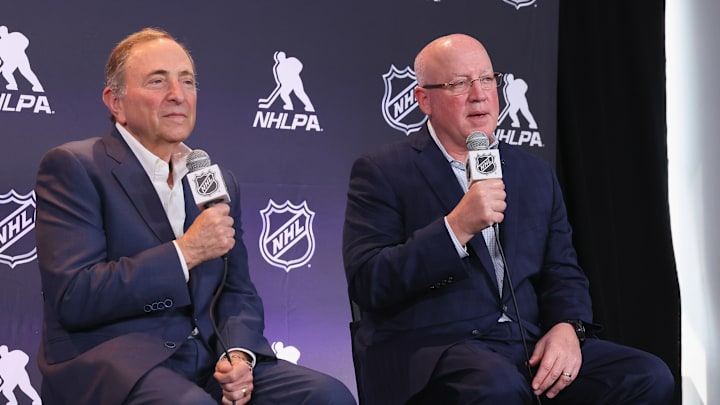
Gary Bettman can go on TNT and ESPN as much as he wants and insist that “the league is growing and more popular than ever.” But compared to what — itself? A sport shouldn’t measure its popularity or cultural relevance against its own past. That’s the very definition of grading an exam on a generous, self‑serving curve
The actual fact of the matter is that US television ratings for the NHL are down significantly. And that is the most accurate measurement of interest.
NHL Playoffs (through first two rounds)
• ESPN platforms: down 28% year-over-year, averaging 886,000 viewers per game
• TNT platforms: down 19%, averaging 882,000 viewers
Stanley Cup Final (Florida vs. Edmonton rematch)
• U.S. average viewership: 2.5 million, down from 4.17 million the previous year
• This is the lowest U.S. Final rating since 2021
• Peak U.S. viewership: 2.8 million for Game 6
So what should the NHL actually do?
The NHL needs to audit and overhaul the marketing department. Bring in talent from other leagues. Study what works elsewhere. Stop pretending the answers will magically appear from within.
Poach the best marketing minds in sports and give them offers they can’t refuse. The narrative around the NHL won’t change until the people telling the story change. And right now, the story is tired, uninspired, and nowhere near as compelling as the sport itself
Right now, the United States only cares about the NHL when the playoffs start or when an international tournament briefly captures attention. The upcoming Winter Olympics should help grow the game exponentially, but we'll see. Temporary connections to the sport aren't fandom. That’s a sponsored Instagram ad — easily forgotten and usually blocked.
The NHL doesn’t need a new campaign. It needs a new identity — one that finally understands the sport it’s trying to sell
 Add us as a preferred source on Google