

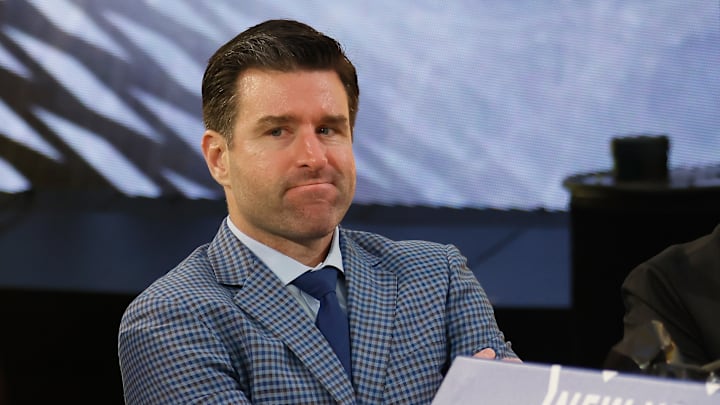
I want to preface this article by saying something upfront: it’s going to make some people in hockey angry, and I genuinely could not care less. It’s the truth — and for some reason, no one in NHL media, from podcasters to national analysts, ever seems willing to say it out loud.
The NHL has the most middling collection of general managers in all major North American sports, and it’s not even close. Sure, there are a handful of strong exceptions scattered across the league, but those organizations feast on an unexceptional majority of front‑office executives who keep their jobs simply because the NHL loves recycling what doesn’t work. Familiarity is valued more than competence.
The clearest and most painful case in point is former Columbus Blue Jackets general manager Jarmo Kekäläinen. At one time, he was one of the longest‑tenured GMs in the league, lasting a crisp 11 years. Over that span, he made a laughable number of costly, shortsighted decisions that repeatedly set the organization back until Columbus finally cut the cord on February 15, 2024 — almost exactly 11 years to the day he was hired.
In more than a decade running the Blue Jackets, he managed just one playoff series win, the famous sweep of the Tampa Bay Lightning. That was also the year he went all‑in, trading away assets while stubbornly holding onto Sergei Bobrovsky and Artemi Panarin — players he knew he could have flipped for a king’s ransom and also knew were walking straight into free agency.
I know it looks like Jarmo is catching strays, but he’s the poster boy for the NHL’s front‑office problem. This is a trend that doesn’t seem remotely close to changing. Most NHL front offices are built from the same recycled pool of former players and executives with pre‑existing ties to the organization — people who either played there, coached there, or were connected in some fashion. And in my opinion, the best candidates are not the ones getting general manager jobs.
But par for the NHL front‑office course, on December 15 — right in the middle of the season — Jarmo Kekäläinen was named the new general manager of the Buffalo Sabres, replacing Kevyn Adams. Ironically, the team immediately went on a ten‑game heater with the roster Adams built, only to have that streak snapped by Jarmo’s former club, the Columbus Blue Jackets.
Rinse, wash, repeat
And that’s really the heart of the issue. The NHL isn’t failing to find good general managers — it’s refusing to look for them, or to stick with the good ones long enough for their vision to take shape. The league keeps dipping into the same shallow talent pool, prioritizing familiarity, old connections, and “he played here once” résumés over actual innovation or proven leadership. It’s a system built to protect the comfortable, not elevate the qualified
So, if you’re wondering why so many franchises stay stuck in the mud for a decade at a time, or why rebuilds drag on until fans forget what hope feels like, this is why. The NHL keeps hiring the same people, expecting different results, and acting shocked when mediocrity shows up right on schedule.
Having said all of that, there’s a tremendous amount of opportunity in this ongoing issue for the good general managers — the ones who truly know what they’re doing — to take advantage of. And many have in the past, most notably former New York Rangers general manager Jeff Gorton. He seemingly cracked the very easy code that every other GM should be following.
A Message from Glen Sather and Jeff Gorton. pic.twitter.com/Q56CXS8vDc
— New York Rangers (@NYRangers) February 8, 2018
When he released "The Letter" to the fans in February of 2018 after a disappointing season, it wasn’t just a message to the fanbase. It was a Trojan horse sent to every desperate‑to‑win GM in the NHL, signaling that the Rangers were open for business. And it’s no coincidence that the letter dropped a full month before the trade deadline.
It made those frantic, win‑now general managers salivate at the chance to poach pieces from the Rangers’ veteran core
In the wake of The Letter, the Rangers didn’t waste time tearing the whole thing down. The 2018 trade deadline kicked it off with a gut punch: New York shipped out its captain, Ryan McDonagh, along with Rick Nash and J.T. Miller — core pieces from multiple playoff runs, gone in one swoop. The following season wasn’t any softer, with fan‑favorite Mats Zuccarello heading to Dallas and Kevin Hayes sent packing to Winnipeg.
Then came the 2020 offseason, when the final — and biggest — dominoes of the teardown finally dropped. Marc Staal, drafted by the Rangers in 2005, was dealt to Detroit. And the hardest move of all: the team bought out Henrik Lundqvist, the franchise leader in wins, shutouts, and basically every goaltending category that matters — except the one fans wanted most, a Stanley Cup.
This was the stroke of genius that brought the Rangers back to relevance quickly and efficiently. The years following The Letter featured a perfect mix of veterans and hungry, ready‑to‑win youth that pushed the Rangers right back into the elite tier of NHL teams.
And of course, predictably enough, just as Jeff Gorton’s master plan was pushing the Rangers back toward becoming an elite contender, James Dolan fired him and team president John Davidson for not being “good soldiers” during the Tom Wilson fiasco. I don’t need to remind anyone how unfairly that all went down — or how it paved the way for the hiring and promotion of the much‑maligned current Blueshirts GM, Chris Drury.
James Dolan wanted someone who would simply do what he said — no questions, no dissent, no pushback. You either fell in line with the status quo, on his timeline and his expectations of how a front office should operate, or you were out
The key to all of this is patience. If you’re a GM and you have a three‑year cushion to get things back on track, that’s the window where you can fleece desperate teams at the deadline — and they’ll thank you for it
It’s the same story every year. There are always about seven to ten teams that truly believe they’re one piece away from a Stanley Cup. And that’s where the golden opportunity lies, pouncing on that very specific blend of desperation and eagerness to please ownership and the fanbase.
Veteran players who fill specific roles are always wildly overvalued at the NHL trade deadline. If you’re willing to trade some pawns who used to be princes, you can eventually land yourself some kings — the kind that help you checkmate the entire league when the time is right.
At the end of the day, this isn’t rocket science. The NHL keeps tripping over the same problems because it keeps hiring the same people. Meanwhile, the few general managers who actually understand timing, leverage, and patience are running circles around the rest of the league — with Bill Zito in Florida being the clearest example right now. Jeff Gorton proved it. Other smart GMs have proved it. The blueprint is sitting right there for anyone willing to use it.
So, in about two months on March 6, 2026, if you’re a GM with a plan, a backbone, and the fortitude to let a rebuild breathe, the league practically hands you opportunities on a silver platter. Deadline panic. Ownership pressure. The annual “one piece away” delusion that sweeps through half the league.
It’s all there for the taking., But like Axl Rose famously sang, '"All we need is just a little patience"
 Add us as a preferred source on Google