

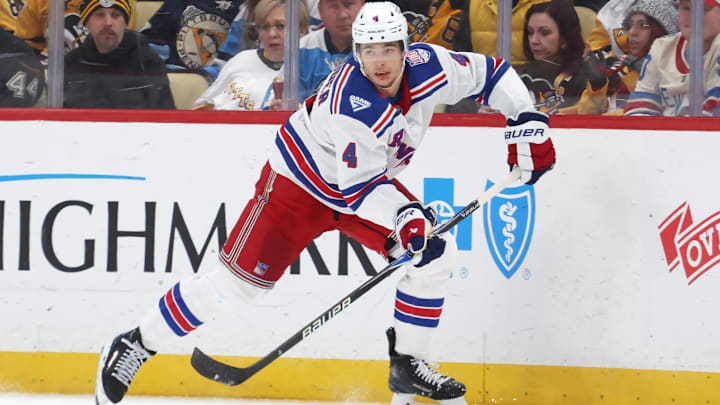
All signs point to the New York Rangers exploring major changes at the trade deadline. Vincent Trocheck’s name has circulated for weeks, but he’s far from the only piece Chris Drury should be considering.
Cue Braden Schneider.
If the Rangers are serious about changing direction, they cannot afford another asset-management misstep. Right now, Schneider represents one of the few young players who still carry value around the league.
The Asset Management Question
Drury’s tenure has drawn scrutiny for how young talent has been handled. Kaapo Kakko was kept for too long before ultimately being moved for a diminished return. Alexis Lafrenière’s trajectory has been similar, leaving his market value murky outside of a potential change-of-scenery deal.

As an NHL general manager, it’s crucial to have the foresight and risk tolerance to make moves to ensure proper roster construction.
Holding too long can erase leverage. Moving too early can look impatient. The challenge is identifying the window of opportunity.
A Development Plateau
When Schneider debuted, he looked like exactly what the Rangers needed — a steady, physical and reliable presence on the backend. Teammates dubbed him “Baby Trouba” for his willingness to step up and deliver punishing hits. As a rookie, he brought energy and stability to a blue line that needed the juice.
The hit on Jesper Boqvist led to Yegor Sharangovich taking an instigator in his fight 🆚 Braden Schneider ⬇️ #NYR #NJDevils https://t.co/Phu1Ps1sl1 pic.twitter.com/AyZETFgeJ1
— HockeyFights.com (@hockeyfights) April 6, 2022
Development hasn’t followed a clear upward trend.
The young defenseman has struggled to consistently put it together. Even accounting for usage fluctuations and last season’s reported shoulder issue, the growth has flattened and his inability to exit his own zone is glaring.
More opportunity hasn’t fully changed the picture. With Adam Fox sidelined, Schneider has seen elevated responsibility, including top-pair minutes and power play looks. The results have been a mixed bag and ultimately, not good enough.
Why the Timing Makes Sense
Despite his inconsistency thus far at the NHL level, Schneider still holds a lot of value around the league. Vancouver reportedly wanted his services as part of the trade package for JT Miller - Drury opted not to go that route.
Right-shot defensemen with size are always in demand. Around the league, right-side depth is one of the hardest assets to acquire. Even if Schneider hasn’t panned out yet, his type still carries appeal.

Reporting from The Athletic’s Vince Mercogliano on the “Flying V” podcast indicated that Drury’s asking price is high — potentially a first-round pick plus a prospect. Whether that ask is met is yet to be seen, but it indicates that there is a market.
If the former first-round pick is still viewed as a 24-year-old defender with untapped upside, that’s a win for New York. If the Rangers wait longer and sign him as an upcoming RFA, that leverage risks disappearing.
Why San Jose Is a logical partner
The San Jose Sharks stand out as the perfect match.
Mike Grier’s club is ready for takeoff after a long rebuild. They accumulated a number of high-ceiling and elite forwards, including superstar Macklin Celebrini. However, their long-term blue line picture remains a question. Beyond veteran Dmitry Orlov — currently the only established defenseman signed into 2026-27 — the Sharks are banking heavily on youth development headlined by Sam Dickinson.

San Jose has stockpiled forward prospects with skill and speed. Igor Chernyshov offers elite upside, with high-end speed. Filip Bystedt has come along nicely in the AHL and also has size and speed that can translate well to the NHL game. Quentin Musty offers top-six upside with offensive creativity. This trio tops San Jose’s prospect pool.

For a Rangers organization that has all but ignored skill and speed in pursuit of being “harder to play against,” injecting that type of forward talent would be significant.
It’s unlikely a one-for-one trade materializes, but on paper, the fit is clear. San Jose needs defensive stability and New York needs to inject skill into its system.
The Bigger picture for Drury
The Rangers are entering a transitional phase. Veterans with trade protection limit flexibility. If Trocheck is moved, Schneider becomes arguably the most movable asset with meaningful return potential.
The worst outcome would be making the same mistake over and over — holding too long, watching value dip, and being forced to sell in a weaker position later.
If Drury can convert Schneider into an intriguing asset, it would represent one of the few wins of his tenure.
The Rangers need impact talent in the pipeline. If Schneider’s ceiling has already been realized in New York, the time to act is now — while the rest of the league still believes there’s more to unlock.
 Add us as a preferred source on Google