

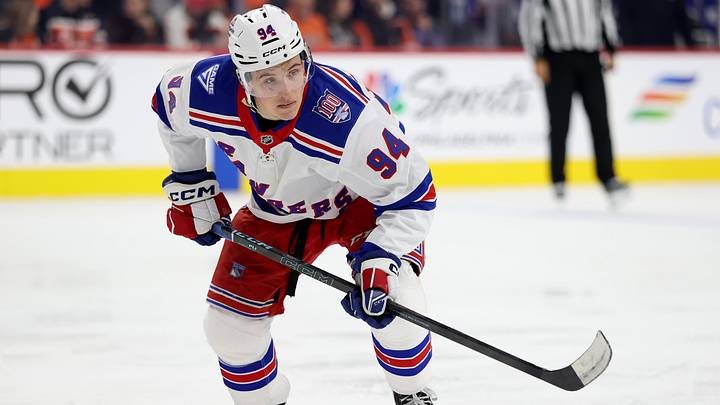
If the New York Rangers wait for Gabe Perreault to show that he's the real deal this winter, it could end up costing them millions of valuable cap dollars that are going to be important as the Letter 2.0 retool continues. Months after closing the book on the Artemi Panarin era, the Blueshirts need to secure its next wave of talent, and the Vancouver Canucks just gave them a roadmap by locking up Zeev Buium.
Rather that letting Buium build up additional statistical leverage after joining the organization as the headliner of the Quinn Hughes blockbuster, Vancouver locked him up through 2035 because of his NCAA pedigree and potential. Chris Drury could decide to take the path with Perreault, and with the NHL's new CBA eliminating eight-year deals in just over a week, the Rangers' window to secure maximum cost certainty is closing quickly. But even though the clock is ticking, what happens next isn't all that simple.
Perreault's situation is more similar to Buium than you might otherwise think
I think a lot has been made about the fact that Buium signed his eight-year mega deal that carries a cap hit of $9.38 million off 76 NHL games, but Vancouver is taking into account who they think he can become. The same would apply to Drury and the Rangers if they opt to sign Perreault to an eight-year deal as well.
Buium has won gold for Team USA at the World Championships, WJC gold twice at the U20 tournament and once at the U18 tournament, he won an National Title at the University of Denver, and a number of other individual honors that are featured on his Elite Prospects page. He was selected No. 12 overall, and considered a top prospect in hockey for a reason, and the organization feels he's just getting started in Vancouver.
Perreault's brief NHL sample this past season, which had him on pace for 18 goals and 41 points, is something the Rangers could look at and be quite impressed with considering he averaged just 15:59 during the stint. They can see how he looked toward the end of the season and be confident in what he did on a bad team where he was a key driver.
But an eight-year deal would be about all the things he's done before this point, and how he was a very special and unique prospect. In case you need a quick refresher, Perreault like Buium has two WJC U20 gold medals and a U18 WJC gold. He did not win a National Title, but he also has a number of other individual honors on his Elite Prospects page.
His resume includes a line of 35-73-108 in just 73 NCAA games, and a record-setting season of 53 goals, 79 assists, and 132 points in 63 games with the United States National Development Program that is better than anything Auston Matthews, Jack Hughes, Clayton Keller, Patrick Kane, or Cole Caufield did in a single season there.
Where Buium and Perreault's situation differs
To be completely honest, and there is always a chance this looks foolish before the September 15 CBA deadline hits, I do not see Gabe Perreault signing an eight-year extension even if Chris Drury put one on the table tomorrow.
It sounds crazy on the surface. Turning down generational, life-changing money would not be easy for a 21 year old. But Perreault is in a position where he is going to make massive money regardless. Zeev Buium is anchoring a rebuilding Canucks team with a murky future following the Hughes trade. In that environment, the risk of developmental regression is real and securing a guaranteed $75 million was smart self-preservation.
Perreault, on the other hand, is walking into an insulated, high-octane offensive setup on Broadway. He does not need to accept an early discount for security when his environment is built for him to produce.
The only way an eight-year deal makes sense for the Rangers is if they can lock him in at a number that feels like a slight overpay today, but ages into massive surplus value as the salary cap spikes.

The current forward hierarchy in New York has Pavel Dorofeyev making $11 million per year through his age-32 season after consecutive 35-plus goal campaigns. Perreault turned 21 in May. An eight-year deal signed before the CBA rules drop maximum term to seven years would carry him through age 29, covering the entirety of his statistical prime.
In an environment where the salary cap is set at $104 million this season, climbs to $113.5 million next year, and is projected to eclipse $120 million shortly after, Perreault's camp has zero incentive to surrender eight years of term unless the AAV approaches top of the market territory which isn't going to happen. Connor Bedard showed the modern blueprint by taking a five-year term at $15 million, ensuring he hits the market again in the heart of his prime.
Why I don't see a deal coming together
So what would an eight-year deal for Perreault actually look like? If the Rangers were trying to replicate Vancouver's blueprint before the CBA deadline, that number would have to land in the ballpark of $13 million a year.
While that sticker price sounds absurd on the surface for a winger with 54 games of NHL experience, that is precisely the point. The salary cap is set at $104 million this season, is projected to jump to $113.5 million the year a new deal would kick in, and could realistically eclipse $123 million the season after that.
From Perreault’s perspective, locking into an eight-year deal right now means forfeiting the chance to cash in on that cap explosion. For his camp to even consider throwing away the possibility to test the market during prime years, they would need a massive upfront figure to protect against that rapid revenue growth.
At $13 million, the contract would eat up 11.46% of a $113.5 million cap in Year 1, quickly drop to 10.5% in Year 2 at $123 million, and eventually settle well below 10% as the cap pushes toward $130 million. By the middle of the contract, that $13 million cap hit would be an absolute bargain for New York.
The Rangers would essentially be making a bet to prevent Perreault from having a breakout 2026–27 season and watching his second contract floor start at $8 million or more on a shorter bridge deal he could springboard off of.

If you think that number is high, consider the recent market of players that would be likely comparables. Juraj Slafkovský signed an eight-year deal with a $7.6 million AAV after a 50-point breakout. Alexis Lafrenière secured $7.45 million over seven years coming off 57 points. Matt Boldy landed $7 million after barely a full season of NHL hockey. I am not including Leo Carlsson's deal because of the offer sheet, and I already mentioned Bedard's situation earlier.
When considering those standard 8.5% benchmarks in the context of the current cap and where it is going, Perreault has every reason to bet on himself. Taking an 11.5% cap hit today on pure projection is impossible for Chris Drury, especially with Igor Shesterkin and Dorofeyev already taking up a chunk of the cap, and that doesn't even take into account what Adam Fox could get on his next deal.
While Vancouver may have truly beaten the buzzer by locking down Buium, for Perreault and the Rangers, the math proves that the smartest move for both sides is to simply let things play out. The Rangers would need to get to a number that is absolutely absurd, and Perreault's in a spot where he just wait things out.
 Add us as a preferred source on Google