

Losses happen—how they happen matters more
Good teams lose games. Even great teams go through rough patches. What stands out during the Rangers’ recent skid isn’t simply the results, but the manner in which they’ve come about. Too often, the offense has stalled for long stretches. Too often, the response after falling behind has been muted rather than urgent. Too often, games have slipped away without a moment where the ice tilted decisively back in the Rangers’ favor.
That doesn’t mean effort has completely disappeared or that structure has collapsed. It means the difference-makers—the players paid and relied upon to swing games—haven’t consistently done so. In a league where one elite shift can erase 40 minutes of frustration, the Rangers have gone too many nights without that shift materializing.
The impact of losing Adam Fox
Any fair assessment has to begin with Adam Fox. He is the Rangers’ best defenseman, their most reliable puck-mover, and one of the few players on the roster capable of dictating tempo on his own. His absence is significant, and the impact is obvious in transition play, breakouts, and power-play rhythm. But context matters. Injuries are not unique to the Rangers, and contenders are measured by how they absorb them. Fox’s injury explains some of the defensive inconsistencies and offensive drop-off from the back end. It does not explain why the forward group has struggled to generate sustained pressure, nor does it fully account for the lack of game-breaking moments elsewhere in the lineup.
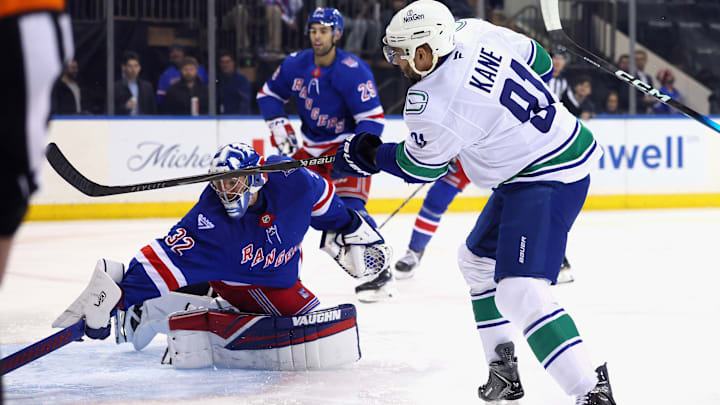
Acknowledging Fox’s importance doesn’t mean lowering the bar for the rest of the roster. If anything, it sharpens the focus on who is expected to step forward when circumstances demand it. Since losing their top blue-liner, the Rangers have slumped to just three wins in their last eight games, with just one regulation win to speak of, and two shutout losses to teams at the bottom of league standings in the Chicago Blackhawks and the Vancouver Canucks, ranked 27th and 32nd respectively.
Rangers are the first team in NHL history to suffer 6 shutout losses through 17 home games.
— Sportsnet Stats (@SNstats) December 17, 2025
As for the forward group
On paper, the Rangers are not short on star power. They have elite players on lengthy contracts, established reputations, and players who have proven they can produce at high levels. The issue isn’t whether stars exist—it’s whether they are consistently imposing themselves on games when conditions are unfavorable. True stars don’t just score when things are going well. They change the feel of a game when nothing is working. They create momentum out of chaos, tilt the ice after a sluggish period, or force the opposition to adjust simply by being on the ice.
During this stretch, that presence has been sporadic at best. The Rangers have had moments, but not enough of them, and not reliably enough to mask other deficiencies. When the team struggles to generate offense, there hasn’t been a dependable sense that someone will simply take over and drag the game back to within reach.
JT MILLER OT WINNER 🚨
— Gino Hard (@GinoHard_) December 14, 2025
THE RANGERS COMPLETE THE COMEBACK AFTER TRAILING 3-0 😱 pic.twitter.com/nHBP1XP7LG
The NHL’s financial landscape has shifted...
This conversation can’t happen in a vacuum. The league’s economics have changed, and the Rangers are navigating the same reality as everyone else. Elite players are commanding more cap space than ever, and contracts for top-tier talent continue to climb. Around the league, franchises have committed massive resources to cornerstone players. The price of star power is rising, and that creates unavoidable consequences. When so much of the cap is allocated to the top of the roster, the room for error elsewhere shrinks dramatically. Depth becomes harder to build, flexibility disappears faster, and every supporting piece needs to outperform its price tag.
Free agency, particularly in today’s NHL, is no longer a reliable place to find undervalued difference-makers. The Rangers’ depth signings are not disastrous, nor are they outright liabilities. They are, for the most part, underwhelming. President and General Manager Chris Drury and company may need to look elsewhere if they plan to add over the offseason, as this year's class that was once one of the biggest opportunities to strike it rich, has been all but spoken for.
Not an indictment, but an honest appraisal
This stretch doesn’t call for panic, but it does demand clarity. The Rangers have enough structure and experience to remain competitive, yet recent games have shown how fragile that competitiveness can be when the margins tighten and the answers aren’t immediate.
The warning signs are not abstract. They are visible in how quickly games tilt when the Rangers fall behind, in how reliant they are on peak-level performances from their top players, and in how little insulation exists when those performances aren’t there. In a league shaped by rising contracts, and relentless parity, that reality leaves little room for error.
The season is far from decided, but the questions are now unavoidable. This team doesn’t need excuses or surface-level optimism—it needs solutions. Whether those come internally, tactically, or through roster adjustments remains to be seen. What’s clear is that the Rangers’ current formula leaves them exposed, and addressing that sooner rather than later will determine whether this season plateaus into another year without a playoff berth, or progresses into something the team and fans can be proud of.
 Add us as a preferred source on Google