

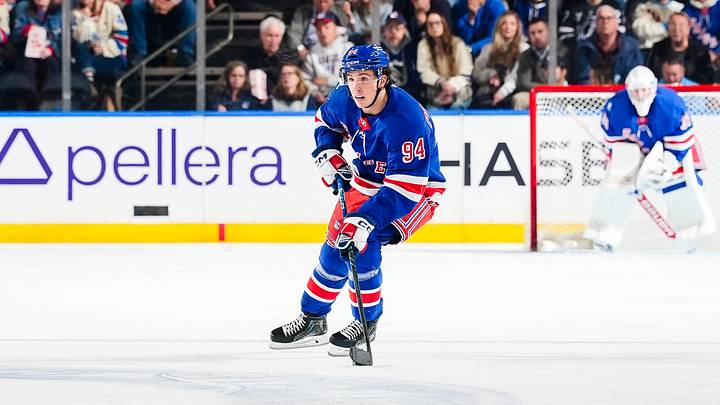
Gabe Perreault’s immediate ascent into the New York Rangers’ top line and first-unit power play has delivered the organization the rare commodity of a homegrown forward development success story.
Through 19 games this season, the 21-year-old winger has established himself alongside Mika Zibanejad and Alexis Lafrenière while notching six goals and three assists. More importantly, his rapid deployment at the top of the lineup proves that Head Coach Mike Sullivan and President and General Manager Chris Drury have abandoned the stagnant development traps that previously stalled high-profile prospects on Broadway.
Breaking the stagnant development trap
For years, the Rangers’ organizational handling of prized young forwards drew justifiable scrutiny. A succession of high-profile draft picks entered the pipeline only to find their development compromised by rigid deployment and punitive roster management. Kaapo Kakko, Vitali Kravtsov, and Filip Chytil never reached their offensive ceilings in New York, frequently trapped on checking lines without sustained top-six linemates or power-play minutes. Even Lafrenière required four full seasons of NHL seasoning before finally breaking through.
It's why so many fans were worried about Perreault entering the season. Sure, he looked good at Boston College and had a lot of hype. But the Rangers' recent history suggests that they would mismanage him and prevent him from reaching his ceiling. But over Perreault's two seasons in the NHL, that has not been the case. He has not fallen into the trap as other Rangers forwards have and is becoming a key piece of the lineup. But what was different about Perreault development?
Earning the promotion and driving play
Last season served as an intentional runway to acclimate Perreault to the professional game. Rather than forcing him straight into high-leverage NHL minutes, the Rangers assigned him to the Hartford Wolf Pack, where he logged 20 games and tallied 10 goals and seven assists for 17 points.
Once recalled to Broadway, Sullivan eased him into the lineup in a middle-six role. As the year wore on and his processing speed adapted to NHL pace, he earned sporadic top-six looks, giving him an opportunity to establish on-ice chemistry with veteran drivers like Zibanejad.
That deliberate foundation paved the way for his breakout in 2026-27. Unlike past lottery picks who were banished to the press box for making mistakes, Perreault was rewarded when he played well.
His underlying metrics at 5-on-5 validate that confidence. According to Natural Stat Trick, Perreault is driving play across the board, boasting a 49.33 CF%, a 54.21 SCF%, and a 54.52 xG%. He is not being sheltered; he is driving possession, processing plays in tight quarters, and converting high-danger looks around the crease.
The blueprint for future talent
The biggest difference between Perreault development and that of the other young forwards is that he got more ice time once he earned it. Guys like Kakko and Lafrenière were stuck in the bottom six for years. It took them years to get a promotion and more responsibility, which set them back for years. This lack of ice time held them back, and they were never able to show off their full talents. Sure, they could not get a promotion right away, but it shouldn't have taken years.
Perreault’s progression must stand as the permanent blueprint for the Rangers going forward. Giving high-end skill players an initial grace period to acclimate in the AHL, transitioning them through the middle six, and then proactively rewarding them with top-line and top-power-play minutes provides the ideal developmental bridge.
For the first time in years, it seems like the Rangers have finally developed a young forward. This is hopefully the beginning of the end to a narrative that has haunted the Rangers for years.
 Add us as a preferred source on Google