

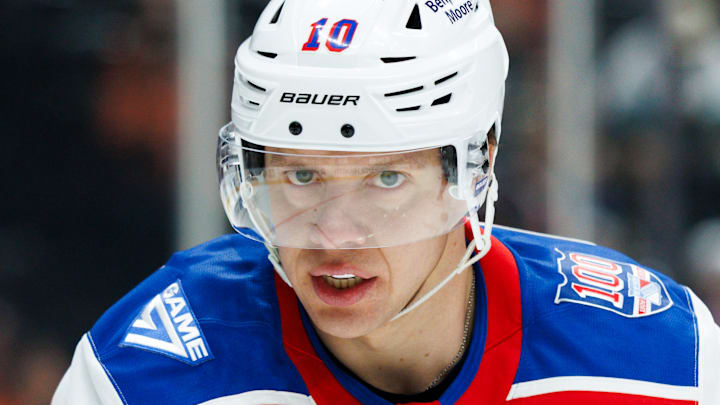
Artemi Panarin doesn’t need to be mythologized to understand his value. Over the last seven seasons, he ranks among the top 5 scorers in the NHL. That’s not a hot streak or a single peak year—that’s sustained, elite production over a long window. The Rangers didn’t simply benefit from that offense; for much of his tenure, they relied on it.
Moving on from that level of offense isn’t about replacing points one-for-one. It’s about replacing the player opponents build their game plan around and still struggle to contain. At the moment, there is no obvious candidate on the roster to assume that responsibility—and that’s the problem.
Retool language vs. on-ice reality
Calling the current direction a retool implies continuity. It suggests that while certain pieces may move, the core identity of the team remains intact. That framing works when succession is clear—when the next focal point is already established or at least trending in that direction. Removing Panarin challenges that premise entirely.
Among the rostered players potentially on the move, Panarin is easily the Rangers’ most sought-after asset, if not one of the league’s most attractive pending UFAs. Another name that could draw significant attention, however, may hold even more value depending on the suitor. Vincent Trocheck, locked in for another three and a half years at a reasonable $5.6 million per season, could be an appealing option for teams in a cap pinch looking to add center depth. The counterpoint to his value is obvious: how does the team remain competitive if both players move on?
One of the few clear bright spots this season has been the emergence of rookie prospect Noah Laba, who has handled extended responsibility admirably in Vincent Trocheck’s absence earlier this season. Unlike the situation on the wing, there is at least a logical pivot to take over if the Rangers find a buyer, with Laba showing an ability to play within structure and keep shifts from tilting the wrong way. That said, projecting him as a long-term solution rather than a capable stopgap would be premature. The distinction matters, because while center depth may have an internal answer, the larger question remains whether the Rangers have anyone in the room who can truly replace elite offensive gravity.
Is the answer in the room with us?
The natural follow-up question is whether the Rangers already have a successor in-house. The honest answer, at least right now, is no.
There are skilled players on the roster and legitimate prospects in the system. Gabe Perreault has shown flashes that justify optimism. His vision, hands, and feel for the game are evident, and he’s clearly part of the organization’s long-term thinking.
But the sample size is far too small to project him—or anyone else—as a franchise offensive focal point. Flashes are not foundations. Expecting a young player to step directly into the void left by one of the league’s most consistent scorers is not development; it’s hope. Beyond Perreault, there isn’t a player who has demonstrated the ability to consistently drive a line, command top defensive matchups, and still produce over an extended stretch. That distinction matters. Scoring is valuable, but offensive engines are rare.
Gabe Perreault records his first multi-goal game in the NHL 🤝 pic.twitter.com/nNs7WwWTOp
— Sportsnet (@Sportsnet) January 15, 2026
The Rangers currently carry the 4th best odds at the number one overall pick in the upcoming 2026 NHL draft. It doesn't take many years at thumbing through their first round draft luck to suggest that this fact doesn't exactly excite many Rangers fans in search of an immediate answer, and I can't blame them. Drafting at the top, or holding that pick to potentially trade for a high caliber player, certainly doesn't hurt the organization. Being able to weaponize it properly, unfortunately, remains to be seen.
League context matters
The broader NHL landscape only sharpens this concern. Elite offensive players are commanding larger portions of the salary cap, and teams that lack one often struggle to manufacture offense consistently, especially in playoff environments. The Rangers already operate in a space where their margin for error has tightened, particularly when injuries or form dips occur.
In that context, subtracting offense without immediately replacing it isn’t just risky—it’s destabilizing. The league doesn’t reward patience at the top of the lineup. It rewards clarity. Teams either know who their offense runs through, or they spend many years trying to find out.
Management cannot sit idly by
This is where accountability enters the picture. The “Fire Drury” chants that have echoed through Madison Square Garden are not simply emotional reactions to losses. They reflect unease about direction and frustration with ambiguity.
“Fire Drury!” chants continue ⬇️ pic.twitter.com/23SBG9rf5k
— Peter Baugh (@Peter_Baugh) January 15, 2026
If Chris Drury is prepared to move on from Panarin, he also has to be prepared to answer the harder question that follows: what replaces him? Not eventually. Not in theory. In practice.
You don’t remove one of the league’s most productive players over the last decade without a defined follow-up plan. Doing so without one isn’t retooling—it’s betting that something will materialize later. That’s not a strategy, especially for a team trying to remain competitive in the present.
Direction cannot be optional
If this is truly a retool, then clarity has to emerge quickly. Moving on from players like Panarin and Trocheck isn’t just about reshaping the roster; it’s about redefining where the offense comes from and who it runs through.
Right now, that answer is incomplete. While Mika Zibanejad has had one of the league's best starts to the calendar year, he's shown many periods over his career to suggest that this level of production should eventually dip. While I highly doubt they choose to move on from J.T. Miller in less than a full 82 game second stint with the Rangers, I don't fault fans for wanting more from their captain. The only clear core discussion with this current Rangers roster starts and ends with Igor Shesterkin and Adam Fox, both of whom's importance has been significantly magnified since losing them to injury.
The responsibility falls squarely on management to articulate and execute a plan that matches the stakes. The Rangers don’t need patience from their fans—they need direction on an organizational level. In today’s NHL, teams without a clear offensive focal point don’t stay competitive for long; they fall into obscurity.
 Add us as a preferred source on Google