

Had you told Rangers fans back in October that the team would lose Igor Shesterkin for the season just six games into their campaign, how many would have written off the year altogether? Yet here they are, still very much in the playoff conversation.
Unfortunately, the same team that had seemingly found its footing after winning six of seven has now dropped three straight. Couple that with an increasingly crowded injured list, and it's fair to wonder how much longer the Rangers can keep their heads above water.
A holiday reality check
For those unfamiliar with the significance of Thanksgiving in the hockey world, the holiday has historically served as a fairly reliable indicator of what the playoff picture might look like come April. Since the NHL introduced its current playoff format in 2013-14, roughly 77 percent of teams occupying a playoff spot on Thanksgiving have gone on to qualify for the postseason.
Of course, there's no shortage of exceptions. You need not look any further than last season's Buffalo Sabres, who went from the Eastern Conference cellar to winning the Atlantic Division.
The Rangers aren't nearly in that kind of predicament. They are currently 13-11-1, sitting just outside third place in the Metro. On paper, that's hardly an insurmountable deficit with almost 60 games remaining.
What is concerning is how little breathing room the Rangers managed to create for themselves during arguably their best stretch of hockey this season. A productive couple of weeks can be quickly undone by a handful of losses, particularly when the teams around you are finding ways to pick up points.
When it rains, it pours
There was never going to be a seamless transition to life without Igor Shesterkin. Credit where it's due, Dylan Garand did an admirable job keeping the Rangers afloat in the absence of both Shesterkin and Joonas Korpisalo early in the season. But just as the goaltending situation began to stabilize, the injury bug found its way through the rest of the lineup.
The latest major casualty is Gabe Perreault, who is expected to miss four to six weeks with a lower-body injury. The 21-year-old joins an injured reserve list that already includes Pavel Dorofeyev, Oliver Bjorkstrand, and Alberts Smits, among others.
As of writing, Perreault, Bjorkstrand, and Dorofeyev had combined for 20 of the Rangers' 71 goals this season, representing nearly 29 percent of their offensive production. For a team that entered the season with legitimate questions about its scoring depth, that's a significant portion of its offense to suddenly be without.
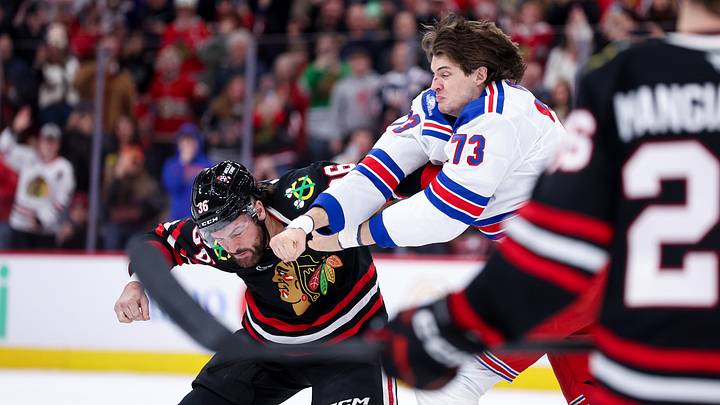
The ramifications were on full display against Chicago on Friday. Despite outshooting the Blackhawks 13-1 in the third period, the Rangers couldn't find an equalizer. It marked the eighth time in their 12 losses this season that they had been held to a goal or fewer.
There's only so much Mike Sullivan can do with his line combinations before he's asking players to perform outside of their capabilities. To make matters worse, a few of the organization's more intriguing forward prospects in Liam Greentree, and Cole Beaudoin are all dealing with injuries of their own down in Hartford, while Adam Sýkora was injured during the preseason.
Keeping up with the neighbors
While much of the conversation will naturally revolve around what the Rangers can do to stay competitive, there's another variable entirely out of their control. The teams around them aren't standing still.
Team | Games Played | Record | Points | Goal Differential | Streak |
|---|---|---|---|---|---|
Hurricanes | 25 | 19-3-3 | 41 | +47 | W3 |
Devils | 26 | 18-8-0 | 36 | +19 | W3 |
Islanders | 25 | 12-8-5 | 29 | +5 | L1 |
Rangers | 25 | 13-11-1 | 27 | +1 | L3 |
Flyers | 28 | 10-12-6 | 26 | -22 | W1 |
Carolina has picked up right where it left off after winning the Stanley Cup, while New Jersey has done little to suggest its place near the top of the division is temporary. Barring a significant change in fortunes, it's difficult to envision the Rangers keeping pace with either of those teams over an 84-game season.
That leaves the Islanders as perhaps the most intriguing team to keep an eye on moving forward. Mathew Barzal is back in the lineup after missing the first month of the season, but the team announced yesterday that Kyle Palmieri will miss 6–8 months with a torn ACL. Meanwhile, Philadelphia continues to linger in the standings, with the added complication of competing against the Atlantic Division for the two final Wild Card spots.
The Rangers could very well finish fourth in the Metropolitan and still find themselves watching playoff hockey from home. With that in mind, the importance of securing points against the teams directly around them cannot be overstated. It's one thing to get outmatched by a team like Carolina. It's another to leave points on the table against a team like Chicago. Those are the games you might find yourself looking back on in April.
Survive and advance
Given everything that's transpired over the first 25 games, it's difficult to be overly critical of where the Rangers currently stand. They lost arguably their most important player less than two weeks into the season and have still managed to give their fans a reason to remain invested heading into December.
The unfortunate reality is that the standings don't account for adversity. For now, success might simply mean staying within striking distance of a playoff spot while waiting for some key pieces to return to the lineup. If the Rangers can manage that over the next month or two, the conversation surrounding this team could look considerably different by the time the trade deadline rolls around.
Conversely, a difficult December could leave Chris Drury entertaining some of the same uncomfortable conversations that occupied much of last season. There's far too much hockey left to be drawing those conclusions just yet. The Thanksgiving benchmark is a useful point of reference, but it is by no means a definitive measure of where a team will finish.
The Rangers have already done an admirable job of making something out of a season that could have gone sideways in October. The challenge now is making sure those efforts don't go to waste.
 Add us as a preferred source on Google