

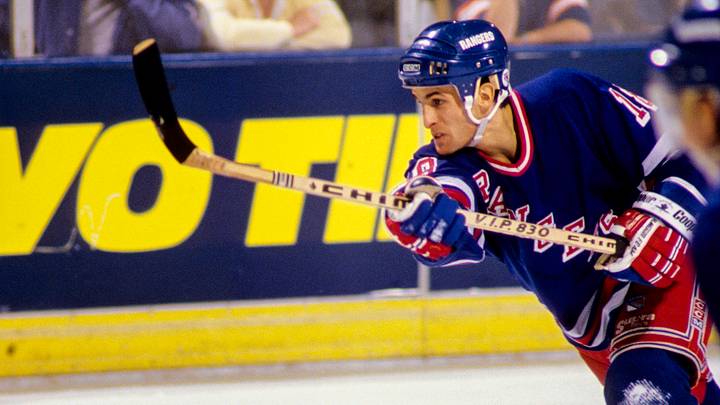
Last season was all about celebrating the New York Rangers centennial season, and throughout the year they looked back on many different eras to highlight some of the players who represented the organization. Over the course off 100 years there have been many different players to sport a Blueshirt, and most fans are familiar with the best of the best.
This includes those who have their jersey retired, and those who have set franchise records. However, there are some names who hold an important part of Rangers history who aren't as well known, and today's just as good a day as any to focus on one such name who played a huge role in the team winning the Stanley Cup in 1994, even though he wasn't on the roster.
Tony Granato's life in hockey started on Broadway
Granato is a name well known in hockey, and that's because in addition to being a player, he's served as a coach and as an analyst on TV. He got his start with the Blueshirts during the 1988-89 season, and it was a debut that took a while after he was selected in the sixth round of the 1982 NHL Draft.
Granato spent four seasons playing at the University of Wisconsin, and during his final season in which he also served as team captain, the 5'10" winger had 73 points in 42 games. In total he graduated with a stat line that included 220 points in 152 games which was very impressive.
Before joining the Rangers, Granato spent 22 games with the Colorado Rangers of the IHL, and 49 games representing the United States on the international circuit before suiting up for the 1988 Olympics.
The following year was Granato's NHL debut season, and he had a sensational campaign which saw him finish with 36 goals, 27 assists, and 63 points in 78 games. To this day, no rookie has scored more goals in a rookie season, and he also has the seventh-best rookie season in terms of raw points.
Granato's time with Rangers was shortlived
After having such an immense impact during his rookie season, it was possible that the Rangers had their next great young player who could continue to develop and help take them to the next level. That did happen, but just in a way that no one expected.
The Rangers have had a knack to chase after star players throughout their history, often at the expense of a young player, and they found themselves in that situation in 1990. In this situation the player in question was Bernie Nicholls, and he was fresh off a 70-goal, and150-point season with the Los Angeles Kings.
Despite his offensive prowess, the Kings were off to a rough start to the 1989-90 season, and the Kings traded Nicholls to the Rangers in exchange for Tomas Sandstrom and Tony Granato. At the time of the trade Nichols had 27 goals and 75 points in 47 games, and he ended the year with 112 points in 79 games.
Granato had 25 points in 37 games, and he ended the season with 11 more points in 19 games played with the Kings. He was much more productive the next few seasons, and had seasons in which he tallied 64, 68, and 82 points with the Kings.
Granato trade set off chain reaction that led to 1994 Stanley Cup
While Nicholls was great during his initial stint with the Rangers, the following season saw his production drop in a huge way. His 1990-91 season saw him score just 25 goals and tally 73 points in 71 games which was a far cry from the 112 he had just a year prior.
The Rangers were in a position to pounce when Mark Messier wanted out of Edmonton, and Nicholls headlined a trade which brought No. 11 to Broadway. The move ended up being a major win for the Rangers as Messier's impact on the organization was instant, and he played a huge role in the Rangers winning it all in 1994.

Nicholls appeared in 421 games after being traded, and in that time he had just 111 goals, 230 assists, and 341 points between the Oilers, New Jersey Devils, Chicago Blackhawks, and San Jose Sharks. Interestingly enough, Nicholls final season in 1999-00 with the Sharks saw him be teammates with Granato who was in his penultimate season as a pro.
With all of that being said, Granato can be remembered to this day as the greatest rookie goal scorer in Rangers history. He can also be remembered as being a key piece of the trade that landed them Nicholls, who then went on to be the headliner in the Messier traded which resulted in a Stanley Cup. It is quite an interesting chain of events, and for that reason he remains an important and quirky part of the history of the New York Rangers.
 Add us as a preferred source on Google